


What should a QR code call to action say? A verb, what the person gets and where it opens: "Scan for tonight's menu at cafe.example.com". Before anyone taps, the phone can show a banner with a name from the address in the code, so make it one your readers know.
Three decisions come before printing: the words, the printed address and the white around the code. The ranking pages list example lines by the dozen; none says what the phone shows.
We decoded the codes in Apple's and Samsung's own help pictures, checked the banner on our iPhone with two default browsers and ran 12,000 simulated scans to measure how close a caption or frame can sit.
What the phone shows before anyone taps
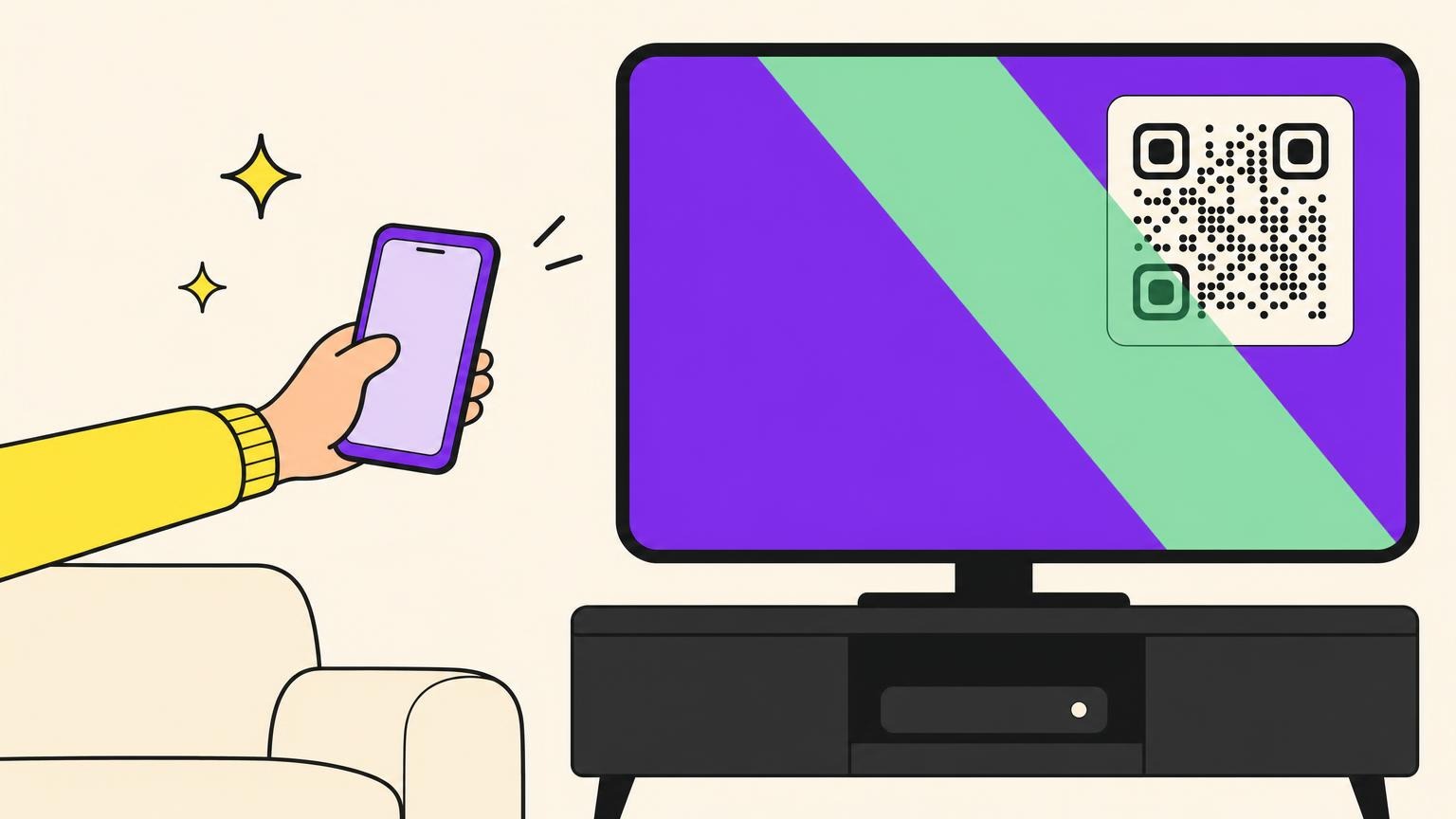
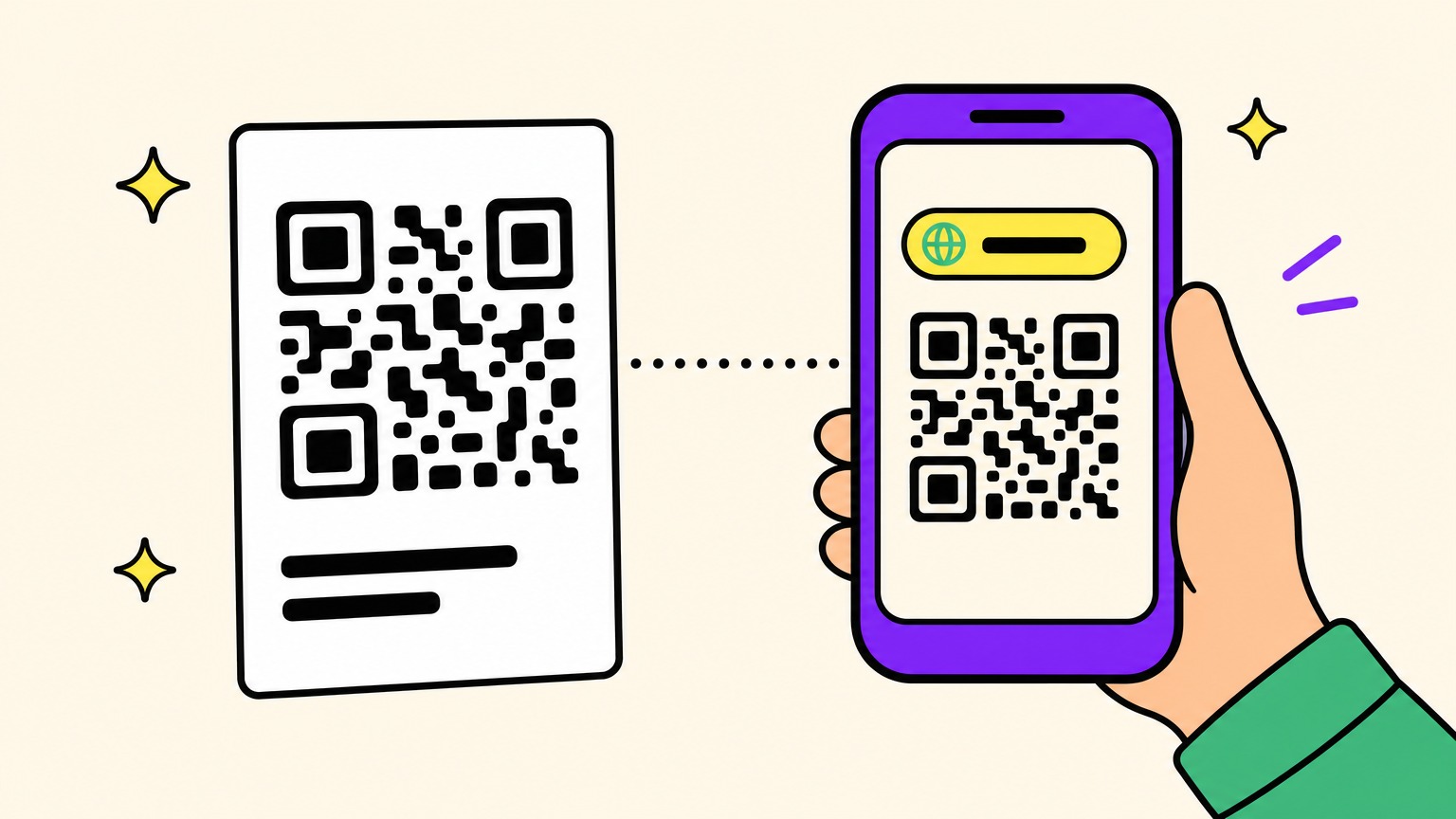
Point a phone at a QR code and a banner appears before anything opens; on our iPhone, whether it named the site depended on the default browser. Apple's QR code support page (September 2026) pictures a yellow pill reading apple.com beside a Safari icon, for a code we decoded as https://www.apple.com.
Samsung's undated screenshot shows www.samsung.com for a support page's full address, and Google's Pixel help speaks of "a bubble or link". Android's redesigned scanner shows the address in an overlay, Android Central reported in December 2025.
Where the banner names the site, it's your code's caller ID: warning about fake QR codes, the FTC (2023) and NCSC Ireland (2025) tell people to check it before picking up. The name depends on the link:
- Your own domain: your name.
- A rented short link or a generator's dynamic link: their domain, such as bit.ly.
- A long address: just its domain on an iPhone, minus any long subdomain, says QR Planet, a generator (2022).
Before printing, scan your code with your own phone and read the banner.
We did, on an iPhone 17 Pro running iOS 27, on 29 October 2026: with Safari as the default browser, a code for our own site showed just the domain; with Chrome as the default, it only offered to open in Chrome, as did four other web links. So the banner is no guaranteed caller ID. When it names no site, your printed words do the whole job, and the next check is the page after the tap: put your name at the top.
The words: a verb, a benefit, and the place it opens
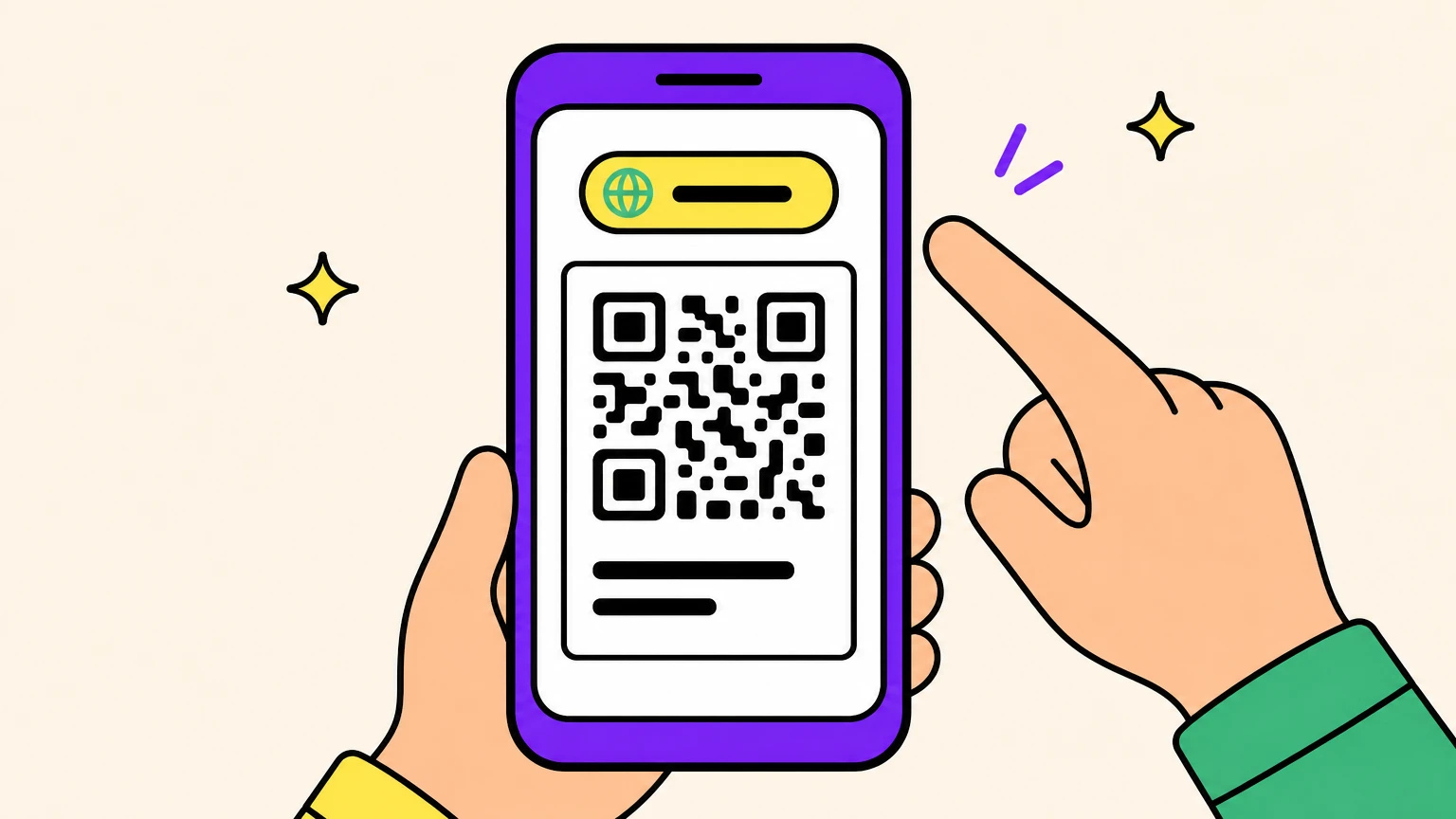
Google's AI Overview and most ranking pages give one formula for a QR code call to action: a verb plus what the person gets. Add what they skip, where it opens, because the banner may not say. The usual lines become "Scan for today's specials at cafe.example.com", "Scan to book on hotel.example.com", "Scan to leave a review on shop.example.com" and "Scan to RSVP at wedding.example.com". On packaging and doors: "Scan for recipes at brand.example.com", "Scan for opening times at library.example.org".
"Scan me" says what to do, not why or where. Tabres, a menu vendor, keeps it for walk-past spots like a queue (August 2026). In an October 2026 r/graphic_design thread about a rural clinic, one commenter calls it lazy; another says older readers ask "Scan with what?" For them, add the how: with your phone's camera.
On 29 October 2026, the AI Overview said two to three words, QRCodeChimp (2026) three to seven. Bitly (2026) puts the line right below, QRCodeKIT (2025) above or beside, Uniqode (2026) above, its FAQ below. None of them measured it, and the gains vendors promise cite no source: up to 173% more scans at QR Code Generator, roughly 70% and up to 80% at QR TIGER (2026), 30 to 80% at Linkbreakers (2026).
Our rule: enough words to say what and where, readable from where people stand. Above, below or to the right made no difference to Apple's reader in our simulation, so choose by layout.
Should you print the web address under the code?
Yes, on anything people hold or stand in front of, short and on your own domain. Nottinghamshire County Council (May 2026) drops the https://; a commenter in that clinic thread keeps the www. for older readers. The US Department of Energy, Section508.gov (October 2024), DAISY's knowledge base and the council all ask for a link alongside the code, for people who can't scan and those who'd rather type. The council's rule: "Never use a QR code on its own."
Gallup (2018) mailed 7,500 survey invitations: 17.0% of the link-only group responded, 18.2% of the code-only group and 18.1% of the group given both. Gallup found no significant difference, saw 4% of respondents use the code and advises always giving the link. A 2024 University of Northern Iowa study (5,500 addresses, mailed in 2022) got 8.31% with code and link against 7.00% with the link alone; neither study tested wording, though QR Code Generator's CTA guide (August 2026) quotes the 8.31%. Among 25 to 34 year olds, Iowa's gap widened: 11.00% against 4.96%.
Two more council rules: a roadside billboard gets a short address and no code, and a static code pointing straight at the page beats a redirect, which can break. A printed address proves nothing alone, though, as another commenter there noted: anyone can print any address. A careful reader checks the banner for the same name, when it shows one.
Short link or your own domain?
Both, if you can: a short address on your own domain. Any short link makes a lighter code: fewer characters, bigger modules, a code that reads from further away. A rented one comes at a price: wherever the banner names the site, your reader sees bit.ly or the generator's domain, not yours, like caller ID from a borrowed phone.
New Zealand's Own Your Online (December 2024) tells people to be cautious when the link over a code is shortened; NCSC UK (2024) says they're right to be. Adrian Kennard, who runs an internet provider, blogged the own-domain case in February 2024: "the preview on a QR code on the phone shows your domain, not tinyurl.com". Digital.gov's undated guide does suggest a shortener for a less dense code.
The fix is a redirect on your side, like tickets.example.org or clinic.example.org/flu, as commenters in that thread suggested. A generator's dynamic code carries your name only if the service lets you bring your own domain, so ask before you print. Either way, the printed address and the link should carry the same name.
How close can text sit to the code? We measured it
Text can touch it, for Apple's reader in our simulation; another QR code needs room. The rulebook is stricter: Denso Wave, the QR code's inventor, asks for "a four-module wide margin at all sides of a symbol" and warns that letters or pictures around a code can make it unreadable. GS1 (June 2026) keeps the code's human-readable text out of that margin too; neither measures what happens closer in.
We simulated 12,000 photos of 2 and 3 cm codes shot from 15 to 40 cm, read by Apple's barcode detector, which matched an iPhone 30 times out of 31 in our QR code tattoo test. Text, a filled band, frame lines, busier surroundings and a second QR code moved in from six modules of white to touching.
Where the bare code always read, 615 of 616 codes still read with text, a band or a line touching them; with a photo texture, stripes, a black background, a barcode or text all round, 277 of 280. From half a module, 5,375 of 5,376 did, and none of these images returned a wrong address. Only the second QR code hurt: touching, the target read 31 times out of 56, and when only one code came back, 25 times out of 28 it was the simpler neighbour. From three modules, both read every time.
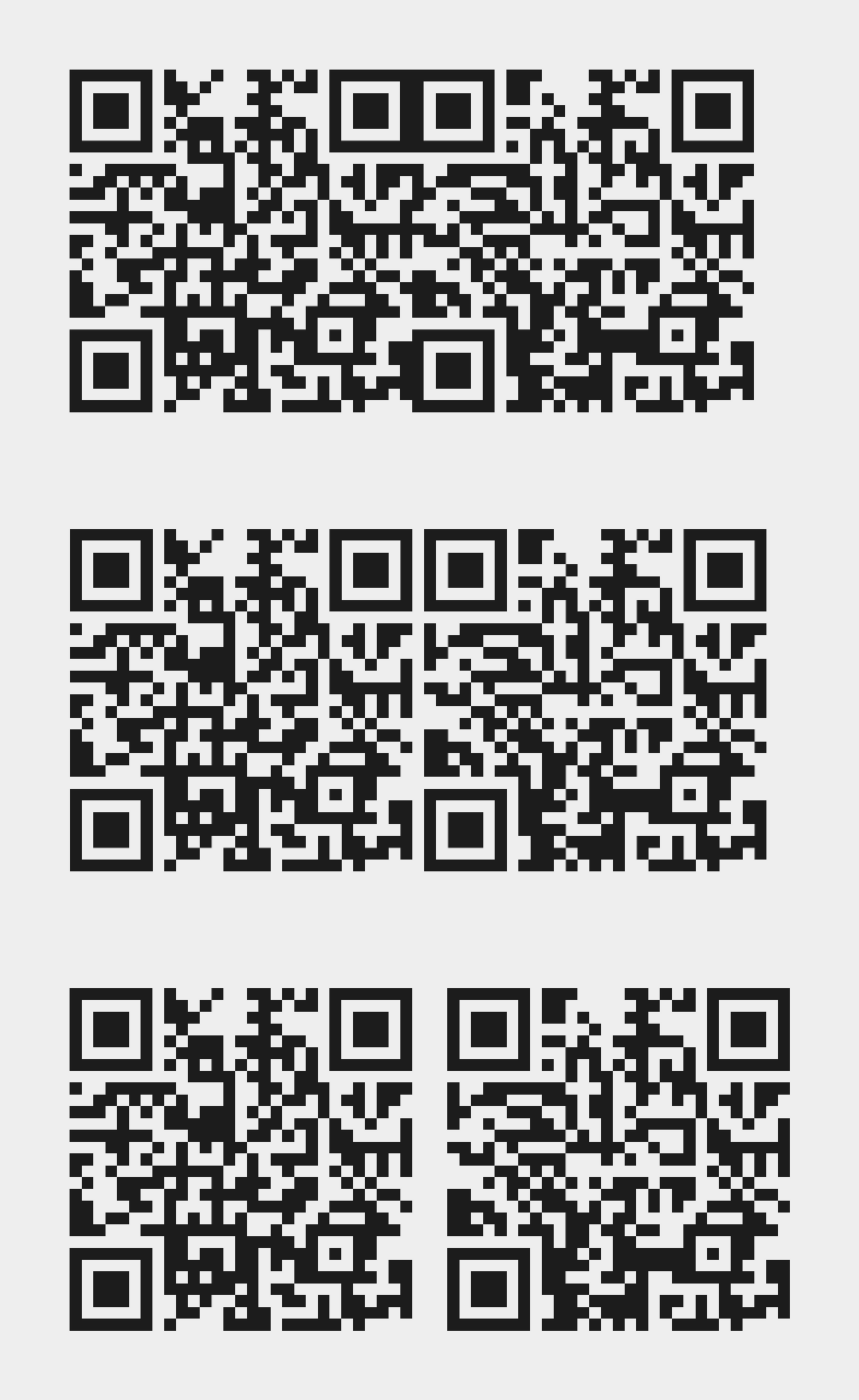
Keep the four modules when the layout allows: we simulated one reader, Apple's, and older or third-party scanners may be stricter. A caption or frame line may come close; a second code needs three modules and its own label. Still failing? See why codes don't scan and how big a logo can be.
Where to put the code
- Put it where eyes and hands go: flat, lit, within reach. Nottinghamshire's guide picks where people naturally look, such as bottom right; QR Code Generator's CTA guide (August 2026), where hands hold the packaging. The US Department of Energy asks for a spot wheelchair users can reach.
- Size it for the distance. The ratios online disagree twelvefold: ten to one in Google's AI Overview, an inch per ten feet on link shortener Choto's blog (October 2025), and neither traces its ratio to a standard or a study. Our minimum-size guide calls ten to one lore; our capacity simulation found it holds for short links, up to about 150 characters.
- Give each code its own place and label, three modules apart. A code per placement, if it's tracked, shows which spot works, as QRCodeStack advises (October 2026).
- Test before you print: scan the proof from where people will stand, with an iPhone and an Android phone, then send it to print.
On screens: email, chat and the Teams blur
On a phone or laptop, people can tap, so send a link; the US Department of Energy says to avoid QR codes on websites, social media and email. On a slide or in a video, also show the address as text and say it aloud, as Nottinghamshire's guide advises.
Since late October 2026, Microsoft Teams has been rolling out a blur on images containing a QR code from senders outside the recipient's organisation, per Microsoft's roadmap (September 2026) and admin notice (updated 26 October). The recipient selects "Reveal QR code" to see it. It's on by default, with no admin control.
Microsoft's documentation (October 2026) says a blurred code isn't a verdict on it, and that on Teams mobile in China the blur also covers internal senders. It speaks of blurring the image, which suggests a call to action drawn inside it is hidden too.
What we do about it
Oh My Code's free generator puts exactly the address you type in the code, with no expiry, so a banner that names the site names yours. Add your words in a frame and download PNG or SVG for free. Our dynamic codes hold a short link on ohmycode.net, unless you use your own domain.
Our simple frames leave 2.3 modules of white, illustrated ones 0 to 3.3, no frame 5.4; there's no margin setting. In our simulation, text, lines and busier surroundings that close cost Apple's reader almost nothing: the measured risk is a second code, not a caption. For the full margin, pick no frame.
Make your code, scan it, and print once your phone shows your name.
FAQ
Does the iPhone camera show the full web address before I tap?
No banner we saw did. Apple's picture shows apple.com for https://www.apple.com; on our iPhone, one code showed just its domain with Safari as the default browser and no address with Chrome.
What does an Android phone show?
Google's Pixel help says a bubble or link appears; Samsung's screenshot shows www.samsung.com for a longer address; Android Central reported an overlay with the address (December 2025). Check your own phone.
Do I need https:// in the printed address?
No: Nottinghamshire County Council's accessibility guide drops it. Keep the address short, on your own domain, with the www. if your readers are older, as a commenter on r/graphic_design advised.
Is "Scan me" enough?
Only at walk-past spots, says Tabres, a menu vendor. Elsewhere it says what to do, not why or where: add the benefit and the place, as in "Scan for today's specials at cafe.example.com".
Does a call to action really increase scans by 80 percent?
Not that we found: the vendor figures cite no study. Mail surveys compared a printed link with and without a code instead: +1.3 points in Iowa (2024), no significant difference at Gallup (2018).
Can two QR codes sit side by side?
Yes, with a label each and three modules of white between them. Touching, a code read 31 times out of 56 in our simulation; when only one came back, it was usually the neighbour.
Will Microsoft Teams hide my QR code?
Yes, if you're outside the recipient's organisation: since late October 2026, Teams blurs the image until they select "Reveal QR code". It's on by default and, Microsoft says, no verdict on the code.