


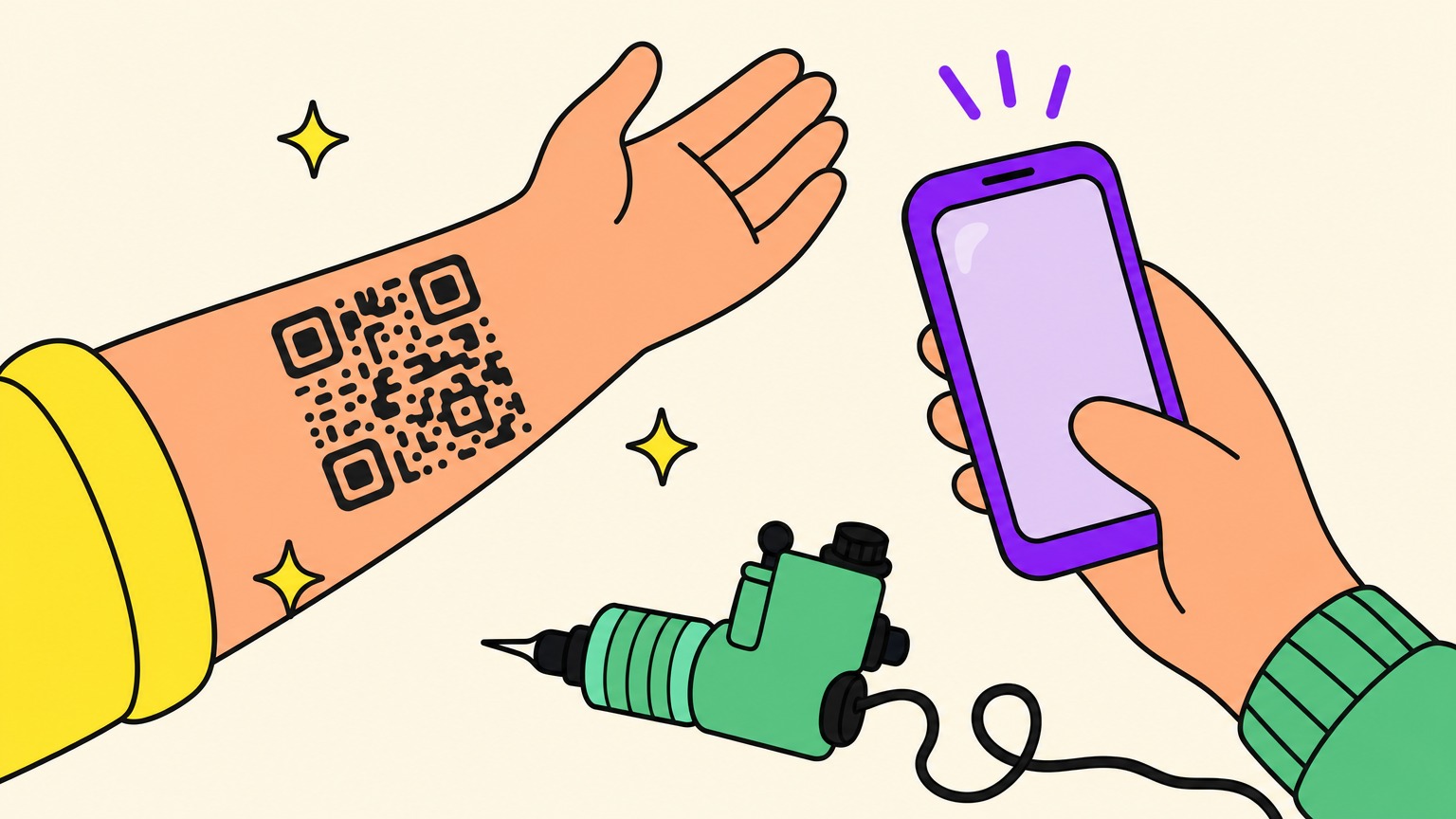
In October 2021, Italian tattoo artist Leonardo Biason told VICE: "We don't know if they will still work in 10 years". Someone who documents their tattoo on Reddit had answered in 2012, before their own session: "I know what it will be doing in 10 years." They meant the link, which would point at their own domain.
Yes, a QR code tattoo can scan for years. One documented 21 x 21 code, 2.75 inches (7 cm) wide on a forearm and pointing at its owner's domain, still scanned after about 12 years, given good light and the right arm position. When one fails, the usual suspects are squares too small for spreading ink and links that die.
That code is theirs: in August 2024, they reported it scans no worse than it ever did. A tattoo is the one QR code you can't reprint, so settle four things before the needle: how much ink spread a code survives, where to put it (both from a simulation on 13,240 code images), which link to trust and how to test it.
QR Code Tattoo Size: Measure the Squares, Not the Tattoo
The guides Google surfaces can't agree on size. Two QR vendors give a minimum of 0.8 inches (2 cm); a third vendor and Google's AI Overview (October 2026) say 2 inches.
Square size matters because ink drifts as the skin cells holding it divide or die. Ian Eames of University College London modelled that drift in 2011: "small details in a tattoo are lost first", and fine detail tends to blur after 15 years, depending on line width. Nobody we found measures that spread in millimetres.
So our simulation measured how much spread a code survives. We generated thousands of code images, 21 x 21 to 49 x 49, in faded ink on light skin, made the black squares swell step by step as if the ink had spread, and asked Apple's barcode detector on a Mac to read each one. Checked against an iPhone on 31 images scanned by hand, off a screen, it gave the same verdict 30 times. The exception was a 49 x 49 code sitting on the limit, which the phone only just read.
Almost every code read until ink had crept about a quarter of a square past each edge; by a third, most had failed, whatever the grid. Error correction, the code's repair kit, didn't help: all four levels failed at the same spread, as in our blur test.
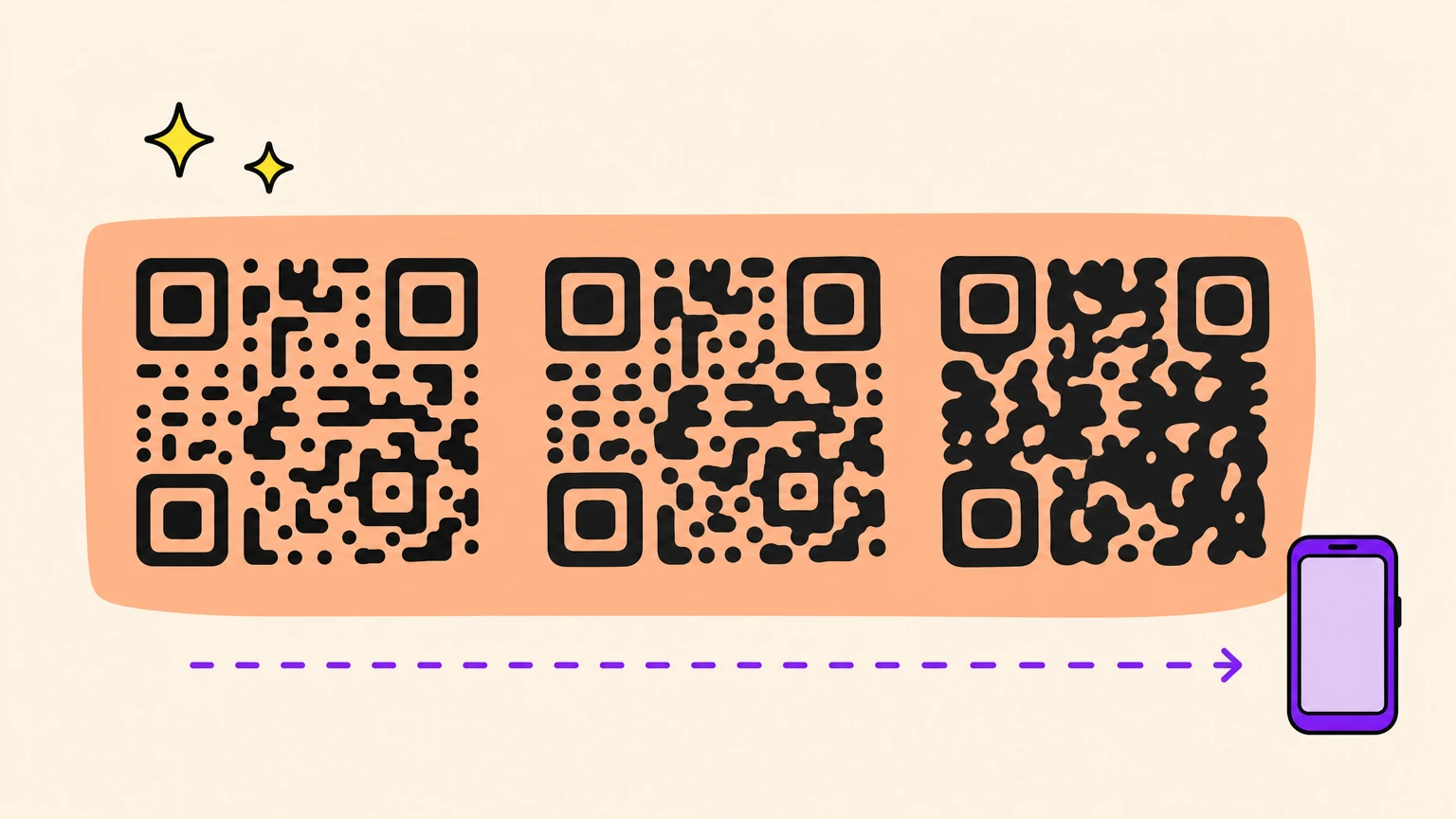
That margin in millimetres, per edge (0.225 x width / squares per side):
- 21 x 21 at 0.8 in (2 cm): 0.21 mm
- 21 x 21 at 2.75 in (7 cm), the 12-year tattoo: 0.75 mm
- 49 x 49 at 2.75 in (7 cm): 0.32 mm
That 0.8 inches is our minimum for a business card, and paper doesn't spread.
Start from about 3 mm (1/8 in) per square, the rule of thumb artists gave the 12-year wearer in 2012.
Where to Put a QR Code Tattoo: The One-Fifth Rule
Twist the wrist or bend the elbow the wrong way, and the 12-year tattoo stops scanning. Against a clean printed code, its owner rates it 3 or 4 out of 10.
Limbs are round, so our simulation also wrapped codes around a cylinder. Every code read while covering no more than a fifth of the way around. Beyond that, error correction earns its keep: our 21 x 21 codes at level L started failing just past a quarter of the way around, while M and Q read to about two fifths. The curve squashes the edge columns, local damage that correction is built to repair.
The iPhone agreed on the pair we checked by hand: a third of the way around, the level L code failed and its level M twin scanned.
Wrap a tape measure around the spot and divide by five. Say your wrist measures 6.3 inches (16 cm): a fifth is about 1.25 inches (3.2 cm), so a 21 x 21 code there gets 1.5 mm squares, half the 3 mm rule. That's where the inner wrist, recommended by Google's AI Overview and a top-ranking tattoo studio, runs into trouble.
Real skin isn't a cylinder: the model is harsh on a flat inner forearm, kind to skin that creases. If the code has to be wider than a fifth, pick the flattest strip, clear of moles and scars, and the highest error correction that stays at 21 x 21.
Aim for 21 x 21: The Simplest Code Your Link Allows
Count the squares along one edge: you want 21, the minimum.
What you encode decides the grid. At level M, the most common error-correction setting, a 21 x 21 code holds 14 ordinary characters, by the capacity table of Denso Wave, the QR code's inventor: https:// plus six for the domain. Type the address in capitals and the code can use a compact mode (capitals, digits, a few symbols) that fits 20. So HTTPS://YOURNAME.COM fits 21 x 21, while https://yourname.com needs 25 x 25.
Not every generator makes that switch, so count the squares. Dropping https:// too, as the 12-year wearer advises, saves 8 more, but phones must then guess it's a link.
Typical grids at level M:
- 20-character short link: 25 x 25
- QR generator's short link (34 to 41 characters): 29 x 29
- YouTube watch link: 33 x 33
- tracked share link: 37 x 37 or more
Error correction's four levels, L, M, Q and H, let a code survive roughly 7 to 30% damage; a higher level can add squares. In our simulation it couldn't beat spread but helped on curves, so take the highest level that stays at 21 x 21: M for up to 20 capitals, Q for 16, H for 10.
Leave four squares of bare skin on every side: a 21 x 21 code 2.75 in (7 cm) wide needs a clear patch of about 3.8 in (9.7 cm). Ink it solid black, without a logo or colour: contrast is brightness to a camera, and fading ink or darker skin shrinks that gap.
Skip Micro QR, despite that top-ranking studio's advice: its biggest size holds less than a 21 x 21 code, the library behind Android's built-in scanner doesn't list it, and our iPhone test read nothing.
QR Tattoo Links Ranked: Borrowed, Rented or Owned
In April 2019, a River Plate fan's calf code opened YouTube highlights of his team's Copa Libertadores final win over Boca Juniors. Trolls reported the video for copyright and it went private (the uploader's doing, YouTube told Gizmodo), leaving his calf pointing at an unavailable video.
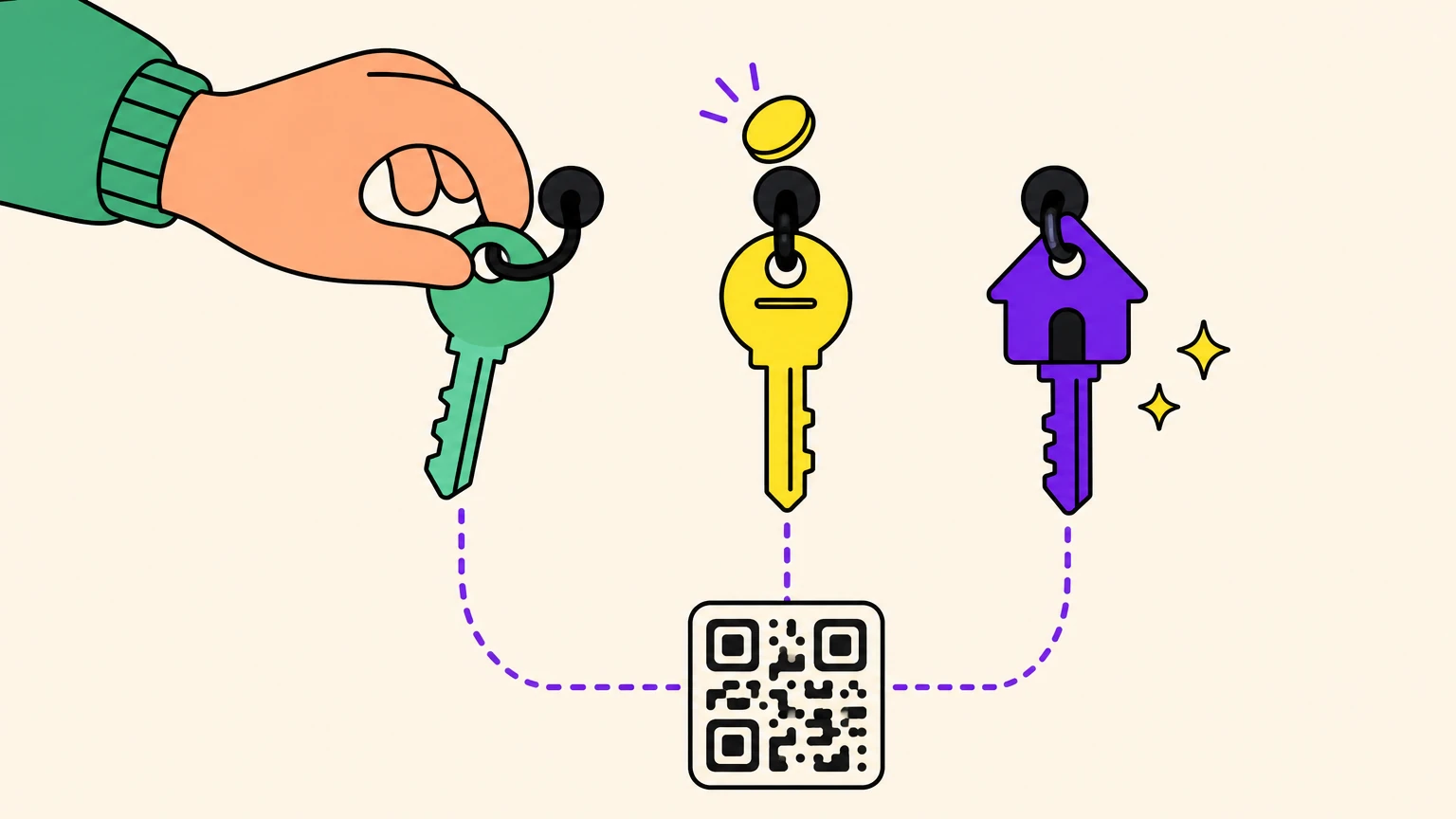
The squares never change, so neither does the address. Ranked by who controls it, worst to best:
- Borrowed: a direct link to someone else's page. Anyone upstream can delete or hide it, and long addresses make dense grids.
- Rented: a generator's dynamic code, really a static code holding the vendor's short link, which the vendor forwards (static vs dynamic). You can change the destination and count scans, but when the trial, the plan or the company ends, the redirect can stop and what scanners see is up to the vendor.
- Owned: a short address on your own domain. Your registrar or DNS provider forwards it wherever you choose, with no server of yours to crash. It lives as long as you renew. Let it lapse and anyone can buy it: in 2015, a Heinz ketchup code sent a German customer to a porn site after its contest domain expired and changed hands (CNBC, June 2015).
On 1 October 2026, two large registrars charged about $11 for a .com's first year and $11 to $18.50 a year after that, so check the renewal price and turn on auto-renew.
If your domain ever points at a QR vendor's custom-domain feature, delete that DNS record when you leave: in late September 2026, a security researcher showed one vendor letting other accounts claim abandoned subdomains to hijack printed codes.
Who Can Scan Your QR Code Tattoo, and Who Won't
Anyone close enough to read your forearm can scan it, and some will. Whoever controls the destination decides what they see. Keep personal details, medical ones included, out of the code itself: a static code shows them to everyone, for as long as the tattoo lasts.
In 2012, Robert Ridge, head of the Canadian MedicAlert Foundation, said paramedics in Canada had been trained for over 50 years to look for medical ID on the wrist or neck, and that for tattoos "the chances of them looking for it are much less". Before an operation, one wearer pointed their code at a surgery meme. Their phone flags every scan, and nobody scanned it, under anaesthesia or in recovery.
Before the Needle: A Six-Step Scan Test
The cheapest test of a QR tattoo costs one sheet of paper.
- Print it at real size. Scan it with the stock camera on an iPhone and an Android phone from about 12 inches (30 cm). Check each phone offers to open the link, especially with capitals or no
https://. - Live with it for a few days, drawn in marker or as a printed temporary tattoo, to judge size and placement.
- Pick an artist with flawless black-and-white work.
- Settle the stencil: printed, never hand-drawn. Some setups need a mirrored file so the code lands the right way round on skin: hand over the normal file and let the artist handle it. A stencil printer can choke on big black areas; in 2022, one client printed outlines inside the black squares for the artist to fill. In our simulation, black squares drawn up to a fifth of a square thinner per edge still read, on the iPhone too, roughly doubling the room before spread becomes a problem. Whether skin holds such thin squares is your artist's call.
- Scan the stencil on your skin before the first line.
- Re-scan after healing (2 to 3 weeks, by one artist's note) in good light at 12 inches, arm in its usual pose.
Make the Code Before You Book the Artist
Skin doesn't come with a reprint button, so get the code right before anyone picks up a needle.
Oh My Code's static QR codes are free, need no account and download as PNG or SVG. Point one at an address you own, and your only subscription is the domain renewal. One caveat on grid size: our generator encodes at level M and doesn't use the compact capitals mode, so a 21 x 21 grid needs an address of 14 characters or fewer, https:// included. An ordinary address comes out 25 x 25, which means about 3 inches (7.5 cm) wide for 3 mm squares.
Rather not run a domain? Dynamic codes are paid, with a 14-day trial, and there's a pay-once option. The dynamic link comes out 29 x 29, so plan on about 3.5 inches (9 cm), on a flat spot. Whichever tool you rent, the address on your skin is safest when it's yours.
Make a code worth the needle, then book the artist.
QR Code Tattoo FAQ
Do QR code tattoos work?
They can. Scanning the stencil checks the code before any ink goes in; staying readable is the hard part. A 21 x 21 forearm code still scanned after about 12 years (Reddit, August 2024), while a Colombian influencer's neck code stopped working within days (RPP, March 2021).
How big should a QR code tattoo be?
Big enough for squares of about 3 mm (1/8 in), an artists' rule of thumb: about 2.5 inches (6.5 cm) for a 21 x 21 code, plus four squares of bare skin around it. At 0.8 inches (2 cm), squares are under 1 mm.
Can you change where a QR code tattoo links?
Only where its address forwards: the squares, and the address inside them, never change. A generator's short link can be re-pointed while the plan and the company last, your own domain while you renew it. A direct link to a video can't.
Can you get a temporary QR code tattoo?
Yes: printed temporary QR tattoos exist, a cheap way to try the size and placement. Don't use one as a scan test: in 2019, one wearer's temporary version lasted about a week and wasn't a working code. Scan the stencil instead.
Do Spotify code tattoos work?
Only in the Spotify app: its Codes FAQ says codes are read by the in-app scanner, need the Spotify logo and can't point to a web page. A code follows the item's URI, so a renamed playlist should keep working. Soundwave tattoos need an app too: Skin Motion charges $39.99 to activate one, then $14.99 a year to keep it playing (both sites, October 2026).
How do you make a rickroll QR code tattoo?
Point the code at an address you own, forwarded to the video, so you can swap uploads: YouTube's oldest copy of the video was pulled in July 2014 while others stayed up (Memeburn). In 2022, a developer's self-built redirect rickrolled a few people, then sent them on to saner pages such as a personal website.