



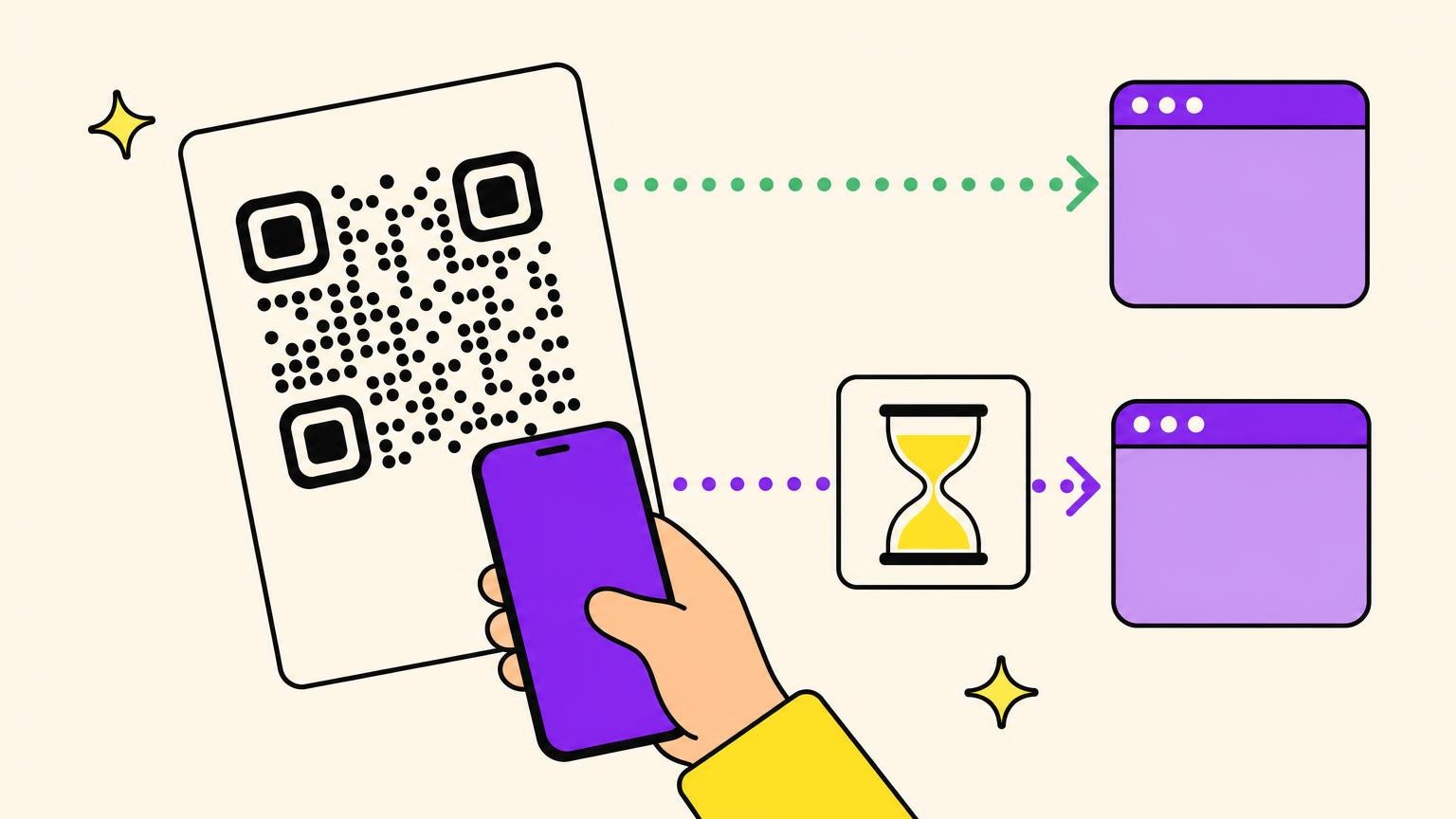
The generator gives you two radio buttons. Static is free. Dynamic wants a card on file. Five thousand flyers go to the printer Thursday, and nothing on that screen says what you are choosing between.
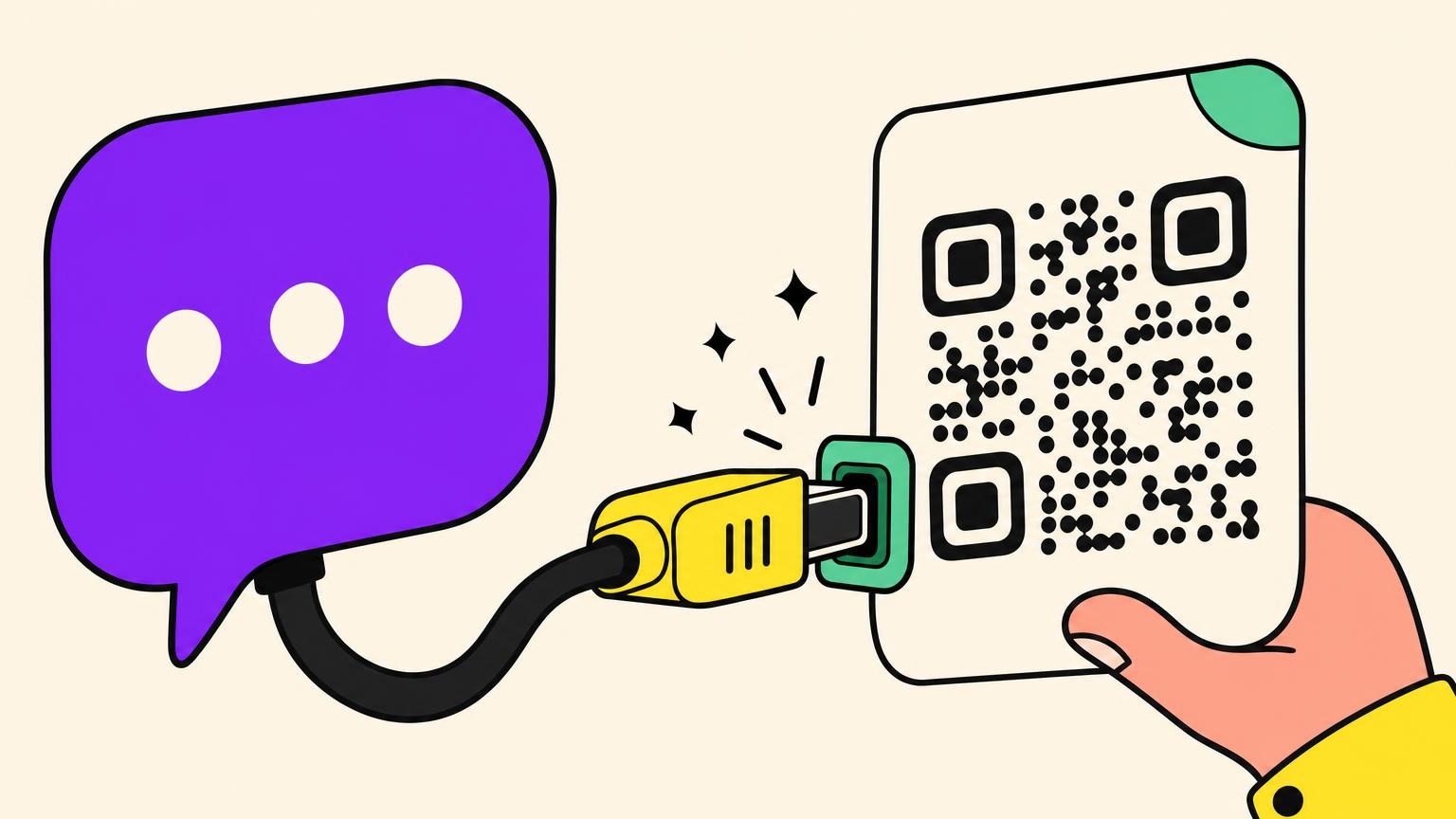
Static vs dynamic QR codes comes down to a dependency. A static code has the destination baked into the printed pattern: no service in the middle, nothing to renew, nobody who can switch it off. A dynamic code is an ordinary QR code carrying a vendor's short link. It can be edited and tracked, and it works exactly as long as that company, its domain and your plan stay alive.
Three things settle it: what has to stay alive for your code to work, what static gives up in exchange, and a one-minute test at the end.
Static vs Dynamic QR Codes: What Your Phone Actually Sees
Your phone cannot tell the two apart, and never could. The camera turns a pattern into text and stops there; everything after that is a URL and a company.
"Dynamic" is not a property of the QR code. The QR standard, ISO/IEC 18004, covers encoding, module layout, error correction and decoding. There is no dynamic mode in it. A dynamic code is an ordinary symbol encoding a short redirect URL that a vendor owns, a convention that dates from around 2008.
Static holds your destination, your Wi-Fi credentials, your contact card. Dynamic holds the vendor's short link: QRCG by Bitly's support page, updated in August 2026, shows qrco.de and l.ead.me as examples and labels the other kind "Static/Non-trackable."
So the choice is between two contracts, not two technologies: a printed fact, or a printed pointer at a service.
| Static | Dynamic | |
|---|---|---|
| In the squares | Your destination | The vendor's short link |
| Editable after printing | No | Yes |
| Scan analytics | None | Yes |
| Has to stay alive | The destination | Company, domain, plan |
| Pattern density | Follows your URL length | Always short |
| Cost | One time | Monthly, usually |
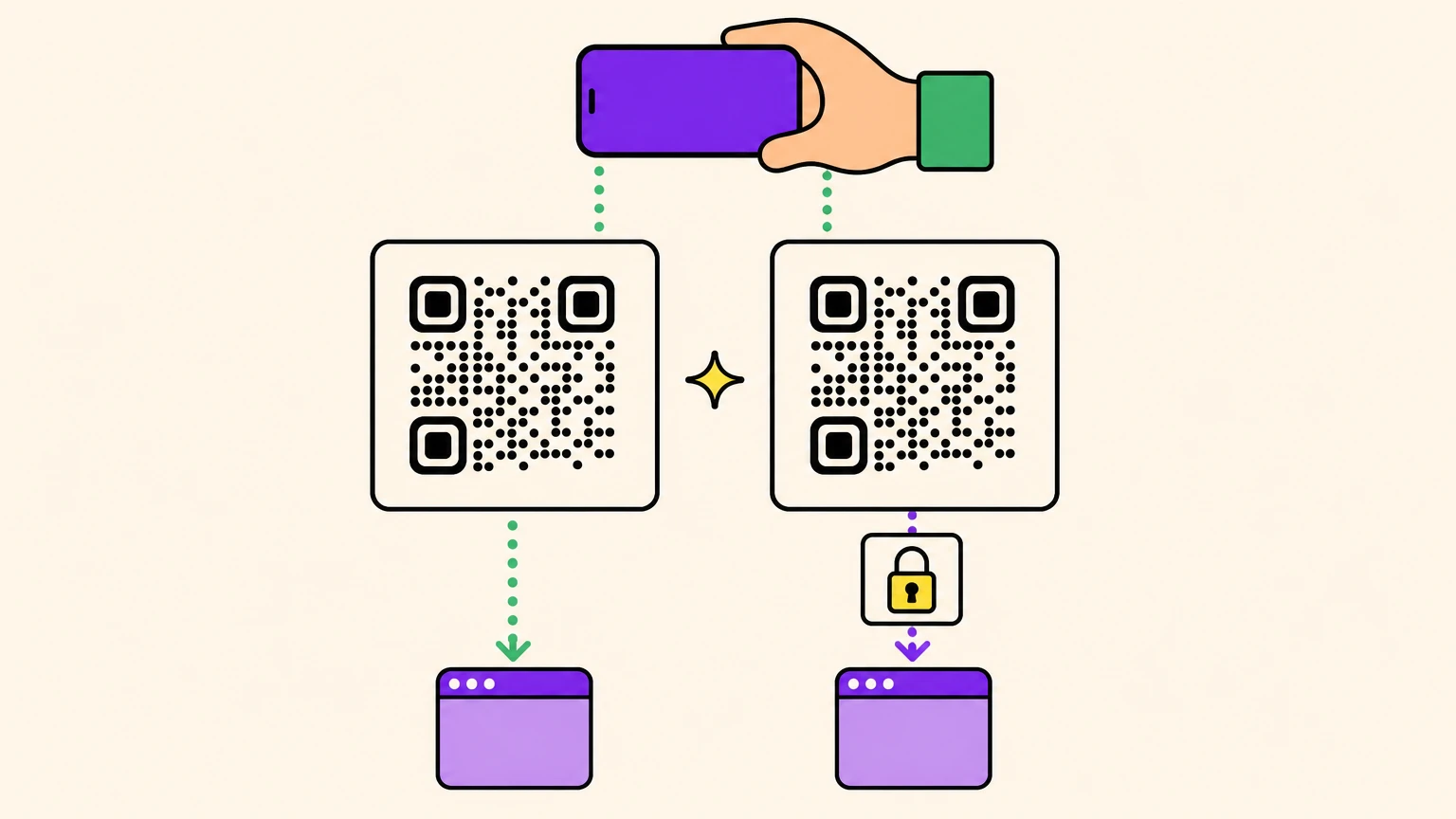
1. Permanence: What Has to Stay Alive for Your Code to Work
A small nonprofit ordered 150 leaflets and 100 business cards carrying a free dynamic code, then learned it would deactivate in seven days without an annual payment. The print run was already on its way.
Five things must stay alive for a dynamic code to keep resolving: the company, your subscription, their redirect domain, their servers, and their lapsed-account policy. A static code has none. Three of the five ways a code dies exist only on the dynamic side; the other two, a dead destination and a worn print, hit both.
QRCG by Bitly's support page, updated in August 2026, says it plainly: dynamic codes "expire once your free trial ends," static ones "remain active permanently."
Past the trial, no two vendors handle a lapse the same way.
QRFY deactivates dynamic codes when its 7-day trial ends. Scanova deactivates them at subscription end, keeping the data 26 months. Hovercode keeps your first three running forever, paid or not. Flowcode keeps the code resolving but takes away the editing.
Big companies do not disappear, goes the objection. Google's own developer blog announced the end of goo.gl: dormant links stopped resolving on August 25, 2025, and only links that still had traffic survived. Wikipedia puts the general case flatly: reliability "is dependent on the continued operation of this provider."
Best for static: anything that outlives a subscription. Plaques, machine plates, signage, Wi-Fi cards. Skip static if the destination is not yours to keep alive.
2. Changing the Destination After the Ink Dries
A cafe swaps its menu in a dashboard and every table tent opens the new page, nothing reprinted. That is the pitch, and it lands. Time rules take it one step further: the same table tent can open the breakfast, lunch and dinner menu by the hour, tested on three time zones at once.
Static's ceiling is absolute: once printed, the destination cannot change. A typo, a rebrand, a moved page: the only fix is a new code. Adobe Express codes are static, and Adobe's own staff confirm they cannot be redirected once made. The same goes for the QR code Chrome generates from its menu: one static PNG, dinosaur included.
The vendors' counterexample is fair: 10,000 packaging units for a promotion that ends, all pointing at a dead offer.
One nuance never reaches the pricing page: editability can be revoked while the code still works. Flowcode's help page says lapsed accounts lose the scan-destination setting, and a downgrade to its free plan leaves only the two newest codes editable.
If the campaign has a known end date, or the destination will genuinely move, the dependency is worth it, on the conditions in items 1 and 5.
3. Scan Numbers, and Who Else Gets Them
Every scan of a dynamic code becomes a row in a database. Yours, and theirs.
The same QRCG page says dynamic codes collect scan counts plus the date, time, location and OS of each scan. Static codes there are labeled non-trackable, which means zero data for you, and that is a real cost.
Analytics capture a timestamp, a device and OS, and a city-level location derived from the IP address, which is an estimate: how far to trust each scan number has its own guide. GDPR Recital 30 names IP addresses as online identifiers, so scan logs can be personal data.
Pixels raise the bar. France's CNIL treats a tracking pixel like a cookie: prior consent for marketing or profiling, a rule it restated in its March 2026 recommendation on email pixels. A redirect page behind a QR code carries the same consent obligation as a website.
The verdict: the vendor sees every scan too, which makes numbers the second-best reason to accept the dependency and the first reason to read a data policy before printing.
4. Pattern Density, Print Size and Failure Points
The same destination, printed the same size, can be a 25 by 25 grid or a 45 by 45 grid. The variable is character count.
The module count per side is four times the version number, plus 17. At error correction level M, Version 2 (25 by 25) holds 26 byte characters, Version 7 holds 122.
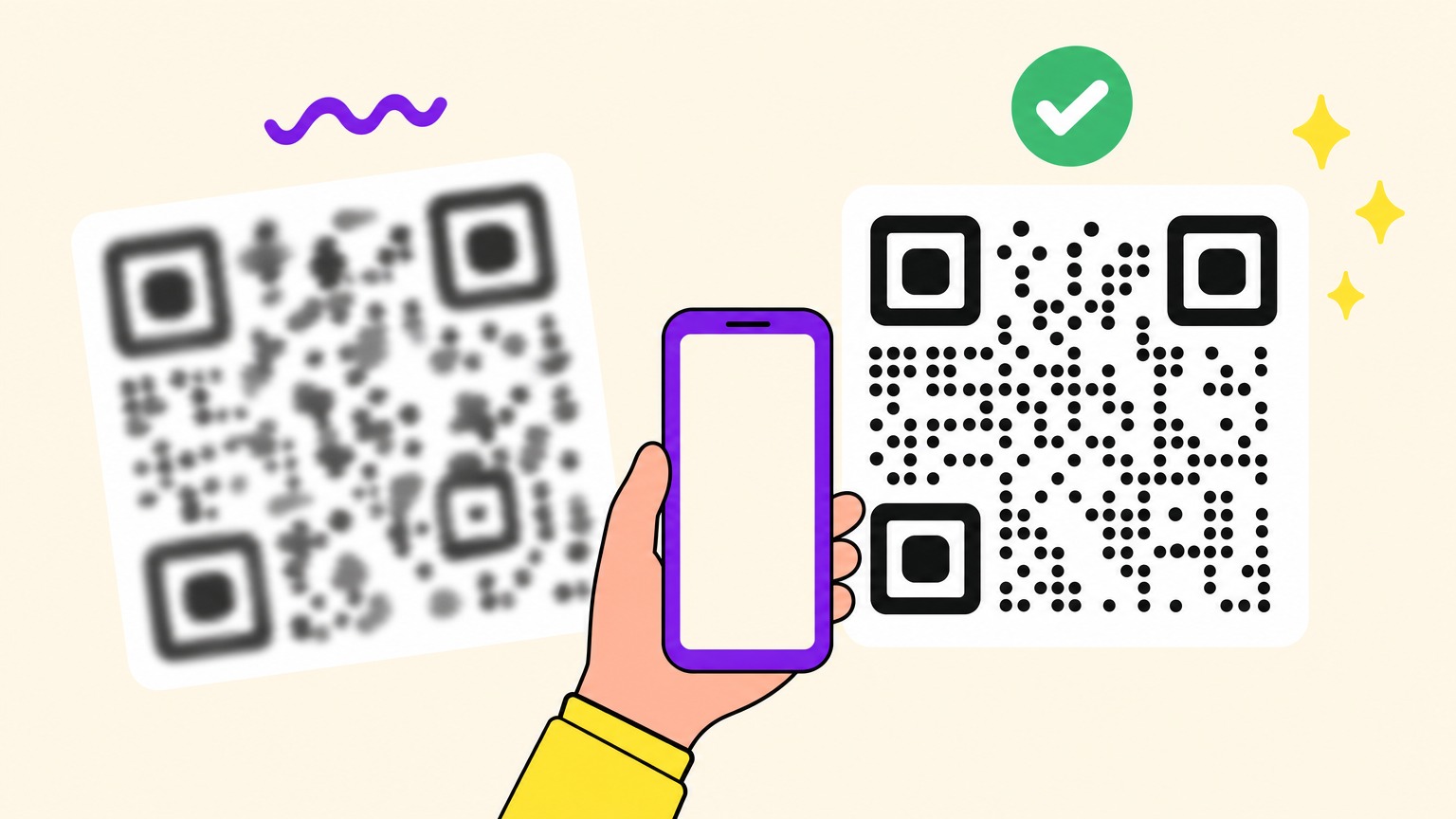
A vendor's short link sits at Version 1 or 2; your URL with UTM parameters lands near Version 7. Same square, half the module size, less margin for the usual reasons a code refuses to scan. Error correction eats capacity too, and whatever the version, print size follows scan distance.
One correction to the vendor pitch: the density win belongs to the short URL, and a static code can carry a short URL too. Density bites when a long URL lands on a business card.
Content type decides offline behavior: text, Wi-Fi, vCard and SMS codes finish on the device, while any URL code needs connectivity and dynamic adds a hop through the vendor's redirect server and DNS.
5. What Each One Costs Over Five Years
Eight euros a month is cheap. Month 60 is the question, and month 61 even more so.
QRCG by Bitly's pricing page (European checkout, September 2026): 8 euros a month billed annually, 96 euros a year, for 2 dynamic codes. Bitly's own product runs free, then $10 and $29 a month. Over sixty months: 480 euros, $600, $1,740.
The other column: bulk flyers run roughly 3 to 11 cents a unit, so a 5,000-flyer reprint costs a few hundred dollars, once.
The third number is what a dead code costs, usually less than feared. The nonprofit from item 1 covered its whole run with 250 pre-cut stickers, 7.50 pounds total. On packaging already in retail, it is the whole run.
Best case for paying: a run big enough that one reprint beats five years of the plan. Skip it when the destination was never going to move.
Which One Do You Have, and What to Do If It Died
Ten seconds and your own camera settle static vs dynamic. No account, no tool.
Scan the code and read the preview before tapping through. Your destination's own domain in the preview means static: nothing sits in the middle. A short unfamiliar domain means dynamic, and the usual suspects are qrco.de, l.ead.me, bit.ly and qr.io.
Image file only? Any decoder shows the same raw text.
A dead dynamic code is confusing precisely because it still scans. What happens next is the vendor's choice: Uniqode sends scanners to an error page and says codes expire if the account is canceled; Scanova shows a "Notify Owner" button that emails the owner.
On an inherited code, ask who holds the login and whose card is on the billing.
Already died? On a small run, a sticker fix is usually cheaper than reactivating a plan. Make a new static code pointing at a URL you control, then cover the old one with pre-cut stickers sized to match. No conversion path exists between the two types.
The Middle Path: Own the Destination
A third option is missing from almost every page ranking for this question. It needs no vendor.
Point a static code at a short path on a domain you own, yourbrand.com/menu. Most hosts, registrars and CMS platforms have a redirect feature, Cloudflare page rules included. Edit the rule; the printed code never changes, and the short path keeps the pattern low-version. A developer can build the same in-house in an afternoon. It's also the setup we recommend for the one code you can never reprint, a QR code tattoo.
Or buy the exit: a custom redirect domain puts your short link under your control. Bitly bundles one into its $29-a-month Growth tier (pricing page, September 2026). The catch applies everywhere: only codes made after the domain goes live use it, so set it up before you print.
One-time plans exist too, a few dozen dollars a code, though the code still rides on somebody's infrastructure. One rule covers all three: be careful pointing a printed code at a domain you do not own.
One question before you print: what happens to my printed codes if I stop paying? The answer lives in the help and pricing pages, far from the signup flow.
The Bottom Line: The Five-Year Test
Three questions, one minute, and the print file is unblocked.
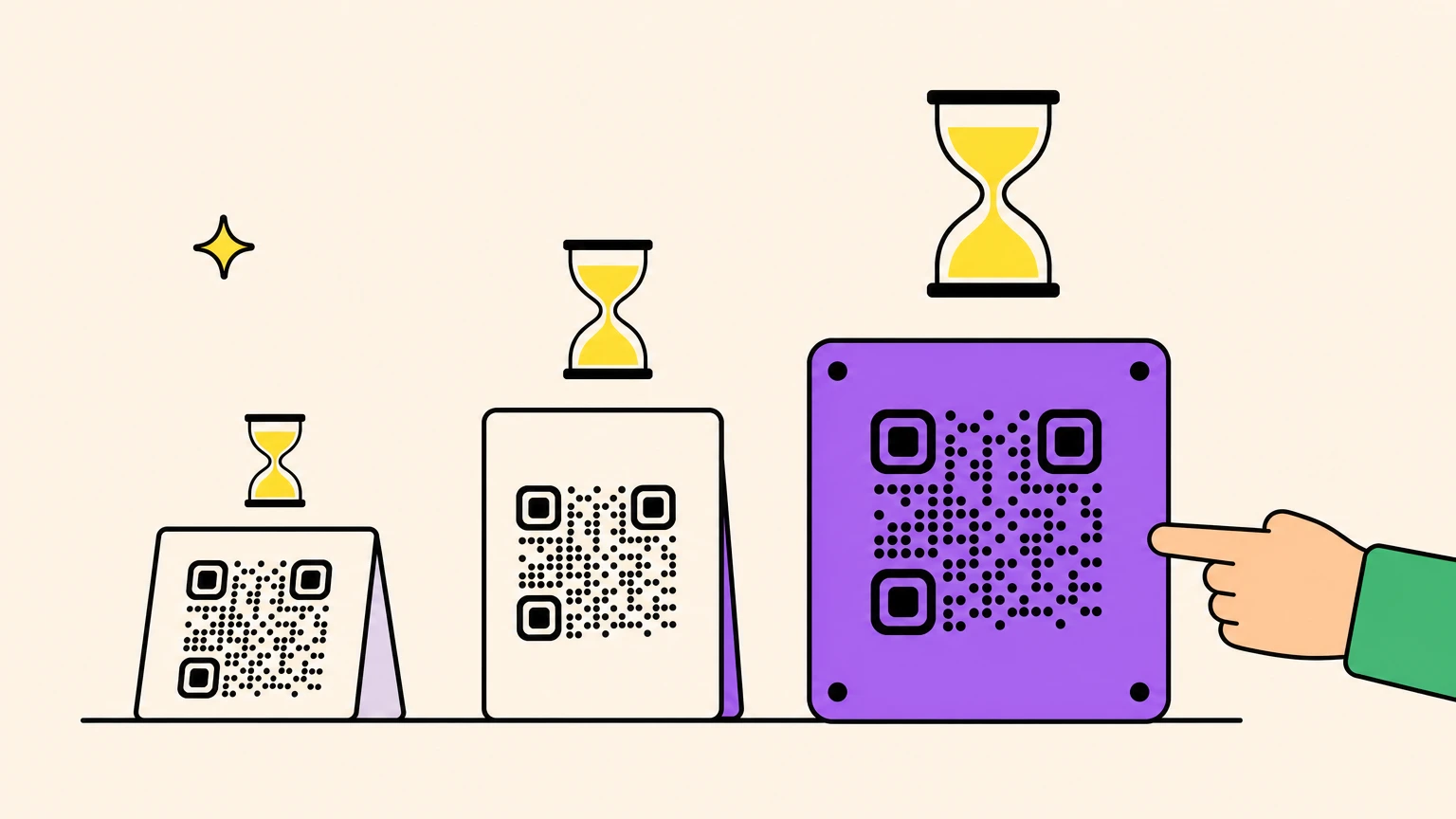
- How long will the printed object live? A table insert, three months. A menu, a year. A plaque or machine plate, ten years and up.
- Will the destination change? Not could it. Will it.
- Do you need the numbers?
Object outlives any subscription and the destination is stable: static, no debate.
Destination will move, one reprint beats the plan, or you need scan data: dynamic earns its dependency, once you know the lapse policy and your exit.
Both at once? The middle path above. One graphic designer on Reddit put it more bluntly: dynamic for non-evergreen collateral, and only with a service you plan to keep paying.
The Part Where We Admit We Sell QR Codes
Full disclosure: Oh My Code is a QR code generator too. Read the above knowing that.
Static codes made here (Wi-Fi, SMS, phone, email) keep working forever, even after the 14-day trial or a cancellation. Physics, not generosity: nothing of ours sits between the scanner and the destination.
URL codes here are dynamic by design, so they need the redirect alive like everywhere else. When a plan lapses, scanners get a clearly labeled "QR Code Denied" page rather than a mystery error. Nothing is deleted, and the codes come back the day you reactivate.
The Friendly plan has a $59 lifetime option: 2 dynamic codes, 500 scans a month, pay once, question closed.
Print something that outlives the plan you are on.
FAQ
Which is better, static or dynamic QR code?
Neither by default. If the object outlives a subscription and the destination is stable, static wins on permanence. If the destination will move, the run is large, or you need scan data, dynamic is worth the dependency. The five-year test above settles it.
Are static QR codes forever?
The pattern is, by construction. Nothing sits behind it to lapse. What it points at is another matter: if it encodes a URL and that page goes offline, the code scans fine and leads nowhere. Forever describes the code; the destination is yours to keep alive.
Can I change a dynamic QR code to a static one?
No. The two are architecturally different, and vendor documentation says so in both directions: no conversion path exists. You generate a new one instead. The printed code is spent, but the next one can point at a domain you own.
Do dynamic QR codes cost money?
Usually, eventually. Most vendors gate them behind a 7 to 14 day trial or a hard scan cap, then a paid plan, commonly $10 to $30 a month on the entry tiers. A minority are genuinely free and permanent, Hovercode's first three among them, so check the vendor. Before you enter a card, see what you actually pay for, and when a free static code does the job.
What does static vs dynamic mean for payment QR codes?
Something else entirely. EMVCo, the body behind payment QR specs, defines merchant-presented mode: a static payment code carries a fixed merchant identifier and the customer types the amount; a dynamic one is minted per transaction, amount embedded. Same in UPI and PIX. Nothing to do with expiry.
What is the FBI warning about QR codes?
The FBI's IC3 warned in January 2022 that criminals paste fraudulent stickers over legitimate codes to route people to sites that harvest login and payment details. A July 2025 alert covers QR codes arriving in unsolicited packages. It is a security question, and how QR code scams work covers it properly.