



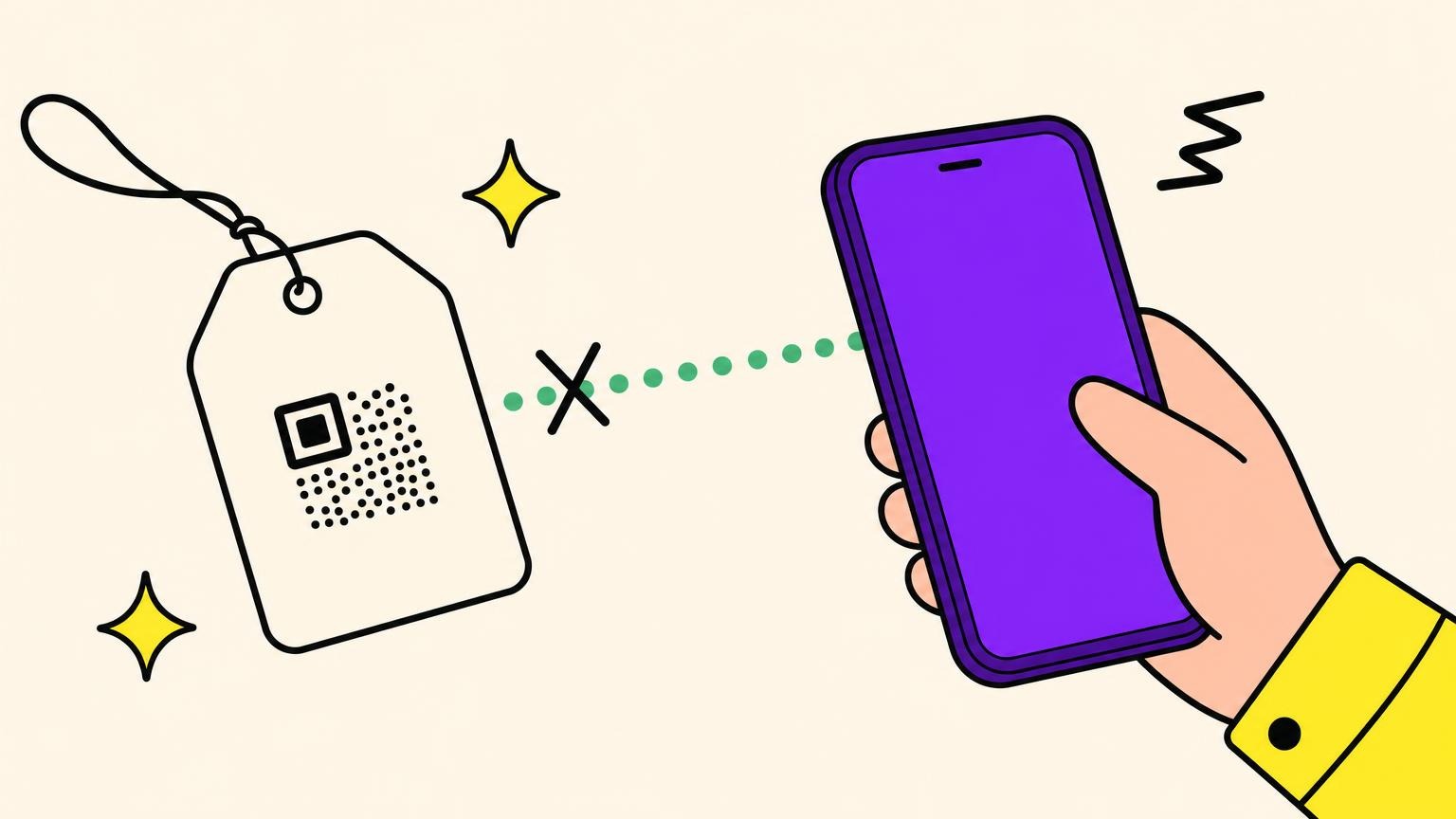
The label is 0.6 in (15 mm) wide and the print run is 5,000 units. The generator offers a Micro QR code: a tiny square with one eye instead of three, holding at most 35 digits, 21 characters or 15 bytes. Most phone cameras will not read it. It was designed for marking industrial parts, not for anything a customer points a phone at.
Dedicated scanner apps and industrial readers handle it fine. The default camera is the one that matters when the phone belongs to a customer.
What it holds, who can actually read it, how much space it saves once you count the margins, and what to print instead.
What Is a Micro QR Code?
One popular QR explainer promises hundreds of characters in something the size of a rice grain. Backwards. Micro QR holds less than a standard QR, and tops out at 35 digits.
A standard QR carries three finder patterns, the big corner squares that let a scanner orient it from any angle. Micro QR has one, plus a 2-module quiet zone instead of 4. That is where the size saving comes from, and where the robustness goes.
| Version | Grid | Error correction | Max digits | Max characters | Max bytes |
|---|---|---|---|---|---|
| M1 | 11 x 11 | none | 5 | not supported | not supported |
| M2 | 13 x 13 | L / M | 10 / 8 | 6 / 5 | not supported |
| M3 | 15 x 15 | L / M | 23 / 18 | 14 / 11 | 9 / 7 |
| M4 | 17 x 17 | L / M / Q | 35 / 30 / 21 | 21 / 18 / 13 | 15 / 13 / 9 |
L, M and Q recover roughly 7%, 15% and 25% of a damaged symbol. Q exists only on M4.
Micro QR is a real standard: approved as JIS X 0510 in November 2004, and inside ISO/IEC 18004 since the 2006 edition, which calls it a variant suited to direct marking on parts and components.
Can Your Phone Scan a Micro QR Code?
Three pages ranking for this term answer the same question three ways: most smartphones read Micro QR natively; built-in scanners cannot; some modern phones handle it. None cites Apple, Google, or a test.
Android is the documented no. The built-in scanner on Android 13 and later with Play Services runs on Google's ML Kit Barcode Scanning library, confirmed by Android reporter Mishaal Rahman. ML Kit's supported-formats page lists four 2D formats: Aztec, Data Matrix, PDF417 and QR Code. Micro QR is not one. Neither is rMQR.
The iPhone is murkier. Apple's Vision framework does list a microQR symbology, so a third-party app that asks for it reads one. But Apple has never published which symbologies the shipped Camera app decodes, and its support article on scanning a QR code names none. The complaint that the Camera app silently fails on Micro QR goes back to a 2019 Apple Community thread, closed without answer. No rMQR symbology exists in Vision.
Denso Wave will not settle it either. Its FAQ says reading success depends on the phone camera and declines to answer for specific handsets. When the inventor will not commit, that is the answer.
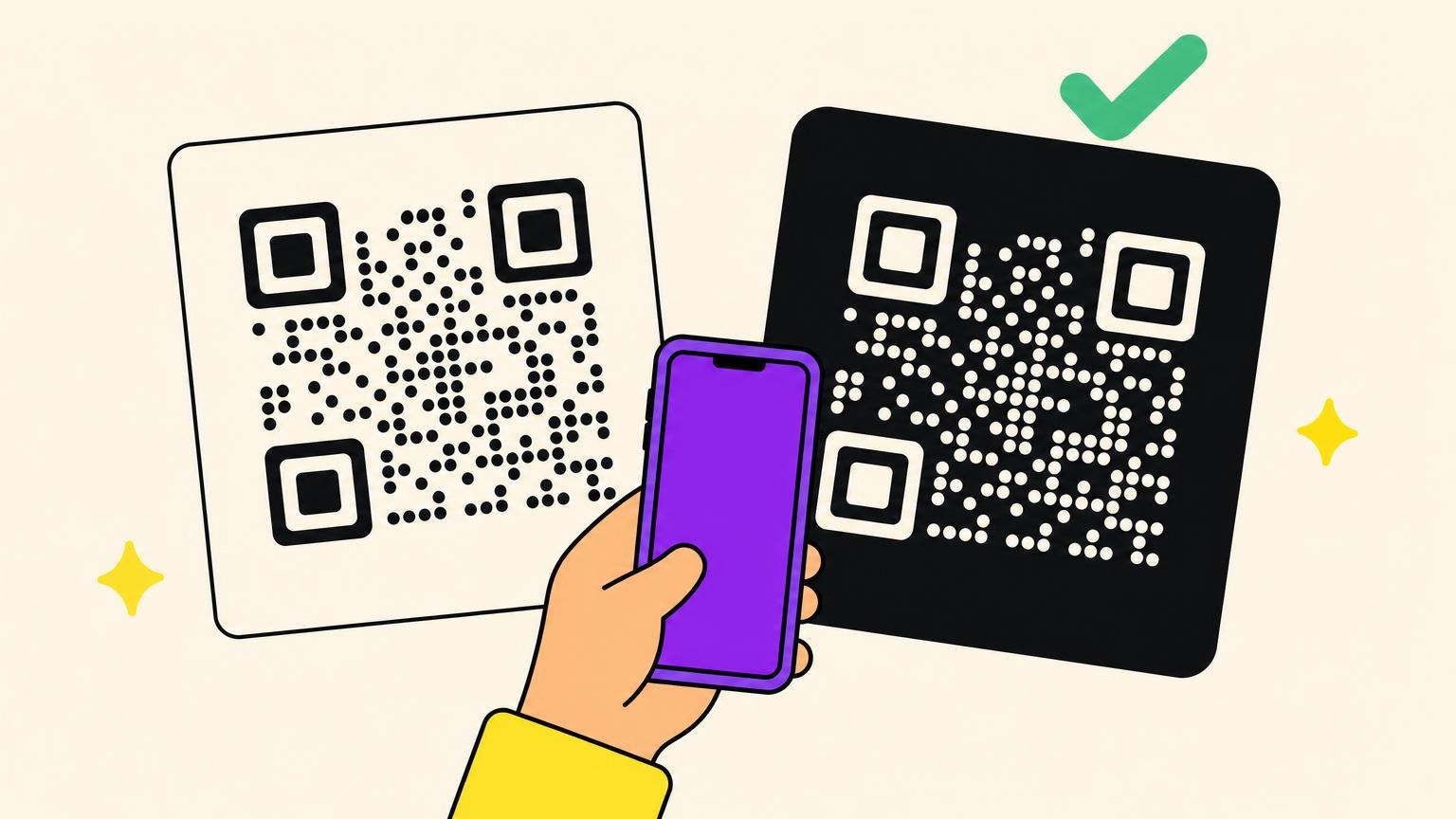
We put the three codes on a screen and pointed our own iPhone 17 Pro at them, on the current iOS release, default Camera app only: the standard Version 1 control scanned instantly. The Micro QR and the rMQR returned nothing.
The rule: assume the default camera will not read it. Dedicated apps and industrial readers do, which is why the format works in a warehouse and dies on a product label.
Five minutes settles it:
- Generate the code at final printed size. Scan it with the default Camera app on an iPhone and a stock Android, no extra apps.
- Scan it again with a dedicated scanner app, proving the code itself is fine.
- If a default camera failed, the code is unfit for customers. Rule out the usual reasons a QR code refuses to scan before blaming the format.
Micro QR vs Standard QR: The Honest Size Math
You are looking at Micro QR for one reason: space. So the only question is how much it buys. Less than the number going around.
M4 is a 17 x 17 grid plus a 2-module quiet zone each side: 21 modules wide. Standard QR Version 1 is 21 x 21 plus a 4-module quiet zone: 29 modules. About 28% narrower in real printed footprint.
The 19% figure circulating on one popular guide compares raw grids only, 17 against 21, and drops the margins. The margins are the part that lands on the label. At a 0.4 mm module, that is about 0.33 in (8.4 mm) against 0.46 in (11.6 mm). You are fighting for roughly 0.13 in (3 mm).
Now the payload. M4 at error correction L holds 15 bytes. Standard QR Version 1 at L holds 17. Two of three finder patterns gone, 28% of width gained, and slightly less data.
For a link it is worse. The https:// prefix alone is 8 bytes, more than half the entire 15-byte budget, before a single character of a domain. Micro QR was built to carry part numbers. A web address was never in its brief.
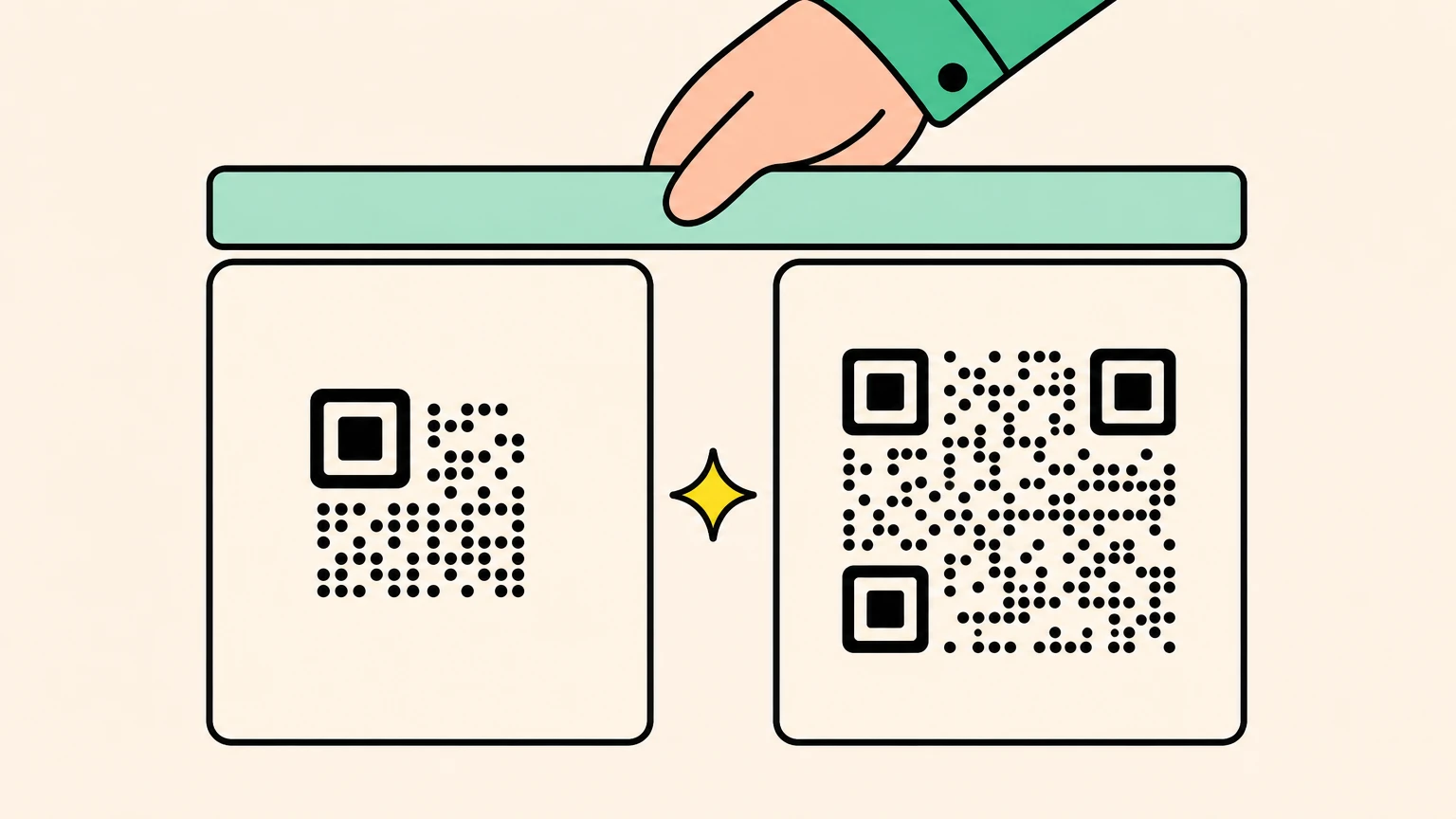
The real answer for a tiny space is a standard QR carrying a genuinely short link. Fifteen characters fit Version 1 at L; Version 2 at L holds 32 bytes, room to spare, and every phone camera reads it. Then size it for the scan distance: the size-by-scan-distance chart does that math.
Rectangular QR Codes: rMQR and the One Most People Actually Want
"Rectangular QR code" means two different things and the results mix them up. One is an industrial standard. The other is a layout. You want the layout.
rMQR, Rectangular Micro QR, is a real barcode standard for narrow spaces: ISO/IEC 23941:2022, announced by Denso Wave in May 2022, from 7 modules high up to 17 x 139, holding up to 361 digits or 219 alphanumeric characters. Unlike Micro QR, that is enough for a real URL.
Reader support is the problem. Neither Apple's Vision framework nor ML Kit lists it, and the Wikipedia entry that calls scanner and printer adoption "still developing" dates from 2022 and has not been updated since. No default phone camera reads one.
The scannable grid of a QR code is always a perfect square. Every rectangular, circular or branded shape a generator sells is decoration placed outside that square, and two platforms that sell those shapes say so themselves. So the rectangular QR code that works is a square code in a rectangular frame with a call to action beside it. It scans everywhere because nothing about the code changed.
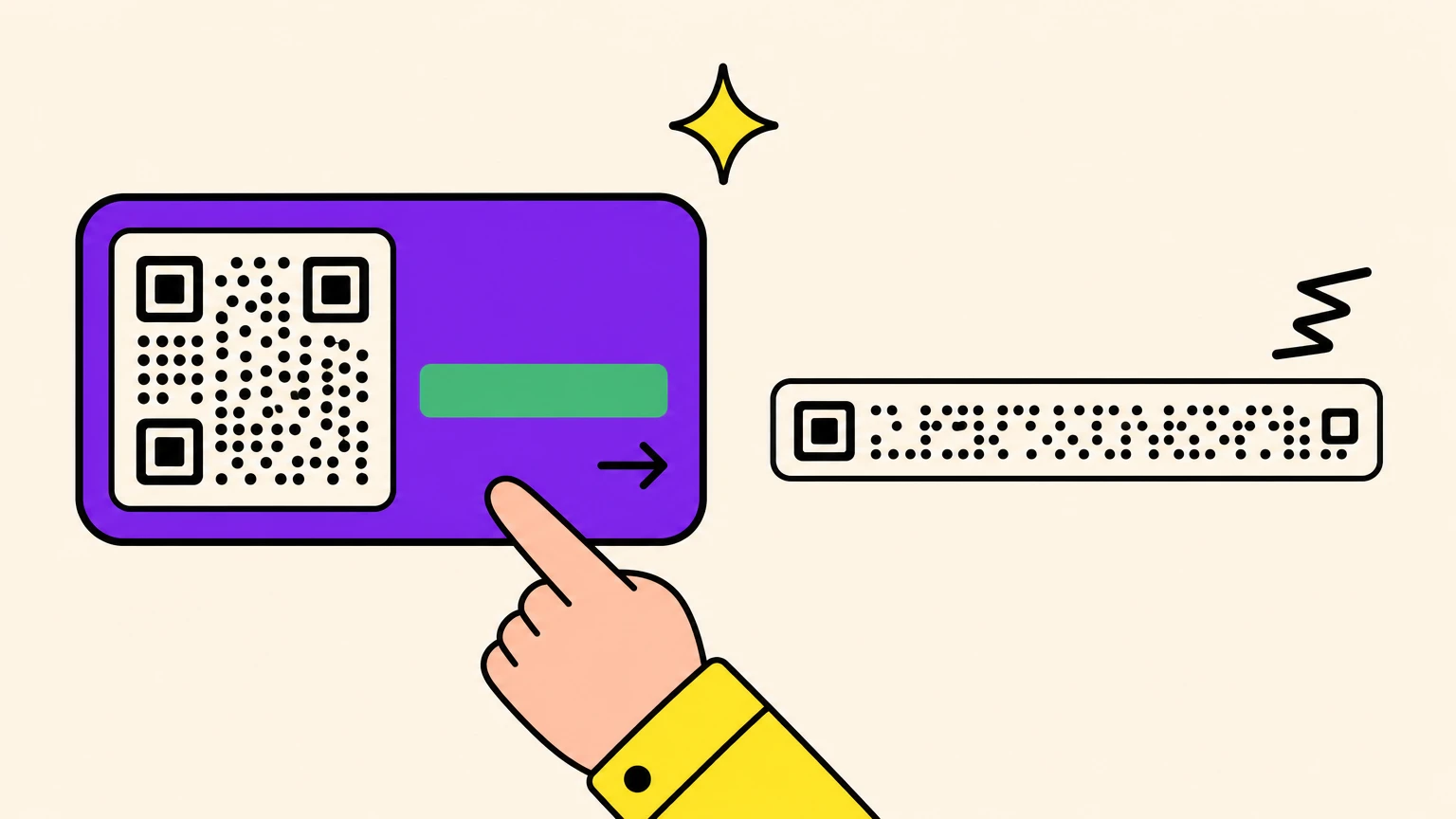
Four rules keep it scannable:
- Never stretch, skew or crop the grid.
- Keep frame, banner and call to action outside the code.
- Leave the 4-module quiet zone clear between code and frame. That is where DIY layouts die.
- Test the layout on real phones before the print run.
When a Micro QR Code Makes Sense, and When It Is a Trap
QR Code was invented at Denso Wave in 1994 by Masahiro Hara, to track car parts on an assembly line with its own scanners at both ends. Micro QR is that world shrunk: closed loop, known hardware, part numbers instead of links. If that is your setup, fine.
Where it wins: printed circuit boards and small electronic parts, tool tracking, closed-loop inventory where you own every scanner, and Japanese industry, standard there since 2004. Those are the categories vendors repeat. Nobody has published a dated case study.
Where it is a trap: anything a customer scans. Product labels, business cards, packaging, menus. One top-ranking explainer says built-in scanners typically cannot read Micro QR, then recommends it for business cards two paragraphs later. A code nobody can scan is not a small code. It is a dead code.
For genuinely tiny marking the entrenched standard is Data Matrix: square symbols from 10 x 10 modules, error correction surviving roughly 30% damage, a direct-part-marking guideline for hard surfaces (AIM DPM-1-2006), and heavy use on pharma packaging through GS1 DataMatrix. It is in Apple's Vision framework and Google's ML Kit, which Micro QR is not.
That still does not make it a consumer format: a scanning SDK vendor says plainly that an iPhone camera cannot scan Data Matrix on its own. Same verdict, different format.
What to Print Instead When the Space Is Tiny
Tiny space, and a customer at the other end? The answer is a smaller payload, not a smaller format:
- Shorten the destination so the code stays at a low version.
- Keep error correction no higher than the print needs.
- Size the code for its scan distance.
- Export as vector so the file survives any scale.
Oh My Code does not offer Micro QR, on purpose. We will not sell you a code your customers cannot scan. What we do sell: dynamic links, 34 characters whatever the destination, so the printed code stays a Version 3, about 0.58 in (14.8 mm), not the dense grid a long URL makes; SVG export, so one file covers a 0.6 in (15 mm) label and a shop window; and 13 frames, 11 with a caption box, for the rectangular layouts people want.
Your competitor is about to print 5,000 labels nobody can scan. Print a code your customers can actually scan.
Micro QR Code FAQ
What is the smallest size QR code?
The smallest standard QR code is Version 1, a 21 x 21 grid plus its 4-module quiet zone. The practical print floor for arm's-length scanning is around 0.8 x 0.8 in (2 x 2 cm). Micro QR goes smaller in modules, not in usefulness. The size-by-scan-distance chart has the number.
Can an iPhone scan a Micro QR code?
A third-party scanner app can. Do not rely on the built-in Camera app. Apple's Vision framework includes a microQR symbology any app can request, but Apple has never documented what the Camera app decodes, and user reports say it does not. Test the exact code on the exact phone before printing.
Can a QR code be rectangular?
Yes, in two senses. rMQR (ISO/IEC 23941:2022) is a real rectangular barcode standard for narrow industrial spaces, from 7 modules high, and default phone cameras do not read it. The rectangular code in marketing is a square QR inside a rectangular frame with a call to action. That grid never stops being square.
Micro QR vs Data Matrix: which one for tiny labels?
Data Matrix, when the scanner is industrial. It starts at 10 x 10 modules, survives around 30% damage, and is the pharma and medical device default through GS1 DataMatrix. It is in Apple's and Google's barcode APIs. Micro QR is not. Neither is a consumer format: the iPhone camera does not scan Data Matrix either.
How much data can a Micro QR code hold?
At most, M4 at error correction level L: 35 numeric digits, 21 alphanumeric characters, 15 bytes, or 9 Kanji characters. M1 has no error correction and stops at 5 digits. Those 15 bytes are why a full URL does not fit.