



Your label supplier emailed, your co-packer raised it on a call, a LinkedIn post finished the job: be compliant by 2027. Nobody said compliant with what. Sunrise 2027 gets talked about like a court date. There is no courthouse behind it.
Sunrise 2027 is a voluntary industry ambition about checkout scanners, not a statute. Exactly one EU law makes the QR code itself compulsory. It covers batteries. The rest is sector rules with dates, frameworks whose clock has not started, and retailers setting their own terms.
That split keeps moving. The Digital Product Passport implementing regulation entered into force on 6 August 2026, the packaging regulation became applicable on 12 August, and the EU's anti-greenwashing rules apply from 27 September. Here is what is law, what is not, and what a small brand does about either. Updated in September 2026 with the 27 September rules and GS1 US's new recall survey.
Sunrise 2027 is a deadline for scanners, not for your product
The deadline is real. It belongs to somebody else's checkout lane.
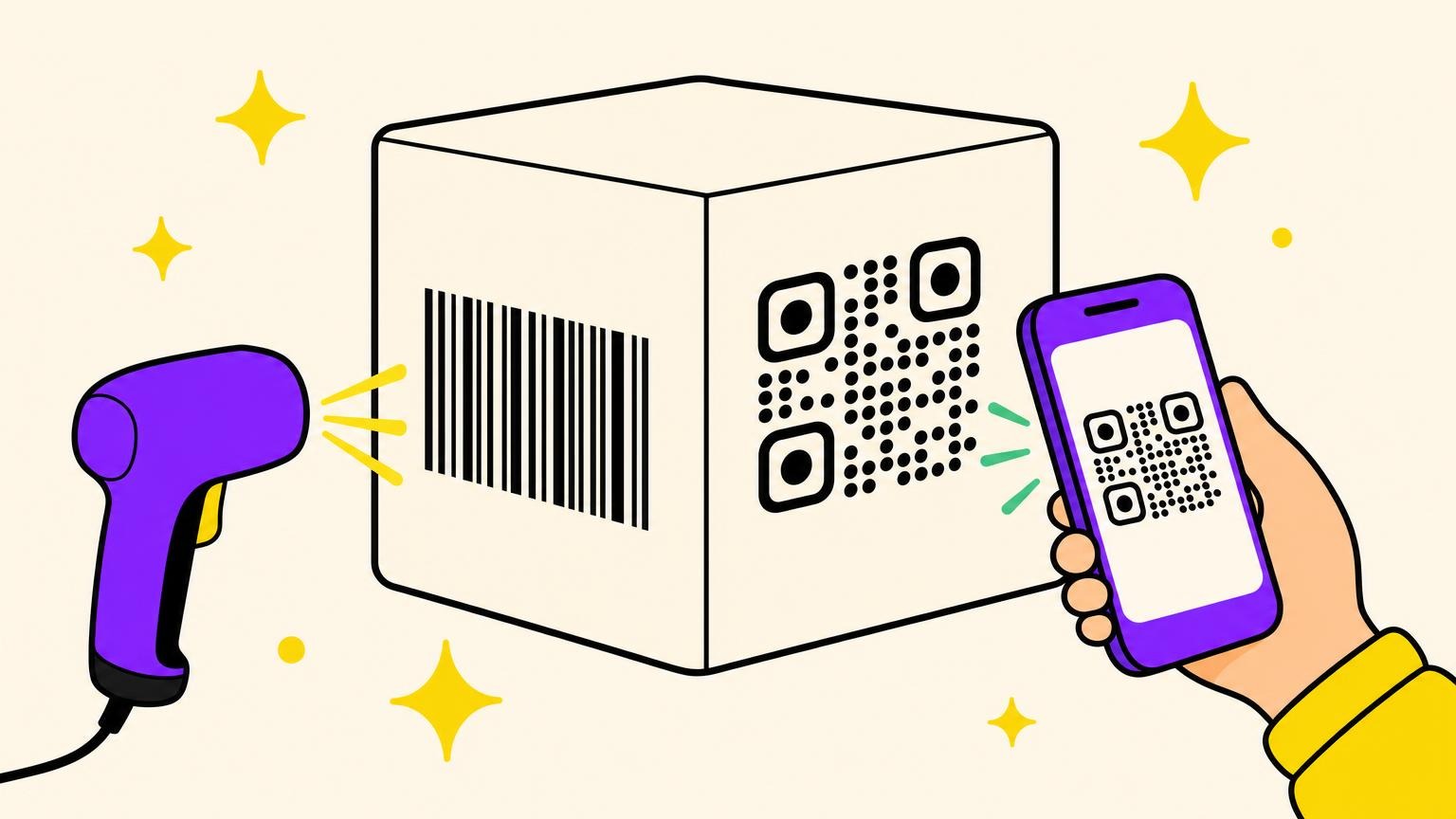
Sunrise 2027 targets retail point-of-sale scanning that reads the GTIN from both linear and 2D barcodes, everywhere, by the end of 2027. It is a capability target for retail systems, not a statute, and it puts no obligation on your packaging.
Which does not make it noise. The joint industry endorsement statement landed on 26 June 2024 with 22 signatories: Carrefour, Lidl, L'Oréal, Nestlé and Procter & Gamble among them. GS1's chief executive called it the start of a second barcode revolution. Pilots run in 48 countries representing 88% of world GDP, with more than 60 retailers committed and Walmart, Kroger and Woolworths testing 2D-enabled lanes.
Shoppers push the same way. In a 2025 GS1 US survey, 79% said they are more likely to buy a product whose code offers more information, and 62% would pay more for it.
The 2026 edition, published on 1 September, adds the safety argument. 94% of US adults are concerned about how often food gets recalled, and 67% have avoided an entire food category after a recall, up from 60% a year earlier. GS1 US's pitch follows: a 2D code that carries the batch or lot number gives retailers and shoppers more precise information when something goes wrong.
A standard can be voluntary in law and mandatory in practice the moment the buyer across the table expects it.
What the law actually requires: batteries, wine, and the Digital Product Passport
Of every regulation waved at you, exactly one makes the QR code itself compulsory.
- Batteries. Regulation (EU) 2023/1542, Article 13(6). From 18 February 2027, every battery on the EU market carries a QR code linking to its conformity declaration. Only light-transport (e-scooters, e-bikes), industrial above 2 kWh and EV batteries need a full passport on top. The duty can land on the device maker, which catches brands that never thought they sold batteries.
- Wine. Regulation (EU) 2021/2117 has required a nutritional declaration, full ingredient list and a QR code or other digital means since December 2023, for wines from the 2024 harvest on.
- The Digital Product Passport. ESPR (July 2024) is the parent law. Implementing Regulation (EU) 2026/1778, in force 6 August 2026, builds the registry and the eIDAS verified-operator step: plumbing, not a product obligation. Duties arrive category by category through delegated acts. Food, pharmaceuticals and animal feed are excluded outright.
- Packaging. PPWR (EU) 2025/40 became applicable on 12 August 2026, and on codes it permits rather than requires: packaging "can also include" a standardised carrier for sorting. The harmonised labelling under Article 12, the part mistaken for a mandate, waits until 12 August 2028 at the earliest.
The pattern holds across all four: everything with a date is sector-specific, everything general is voluntary.
27 September 2026: green claims on packaging, and where the QR code fits
The next date on the calendar is not about barcodes at all. Directive (EU) 2024/825, on empowering consumers for the green transition, applies from 27 September 2026. Do not confuse it with the Green Claims Directive, a separate proposal stuck since June 2025, when the Commission said it intended to withdraw it.
From that day, three practices are banned outright on anything you sell to EU consumers:
- Generic environmental claims. "Eco-friendly", "green", "climate-friendly packaging", unless you can demonstrate recognised excellent environmental performance, such as the EU Ecolabel.
- Home-made sustainability labels. A label has to rest on a third-party certification scheme or come from a public authority.
- Offset-based product claims. No more "climate neutral" product because you bought carbon credits.
The Commission's June 2026 Q&A on the directive, which is staff guidance rather than law, is blunt about timing: any sustainability label on the market as of 27 September 2026 must comply, and the directive provides no transition period.
Here is where the QR code fits, and where it does not. A claim stops being generic when its specification sits "in clear and prominent terms on the same medium", and the directive names the product's packaging as one such medium. "100% of energy used to produce this packaging comes from renewable sources", printed on the box, passes that test. "Eco-friendly, scan to learn more" does not: the detail sits on another medium. A QR code cannot rescue a vague claim.
What it can carry is the evidence. A claim about future performance, "net zero by 2030" for instance, needs a public implementation plan, regularly verified by an independent expert whose findings are made available to consumers. The same Q&A says a QR code on the packaging that leads to the plan and the findings on your website is enough. The Commission accepts the method. Nothing in this directive requires a QR code on your product.
GS1 is already working on the plumbing. In a pilot announced in June 2026 with TCO Certified and Amazon, GS1 US tied certification data to the product's GTIN and cut verification from 15 to 30 days to seconds. The GTIN is the same identifier a Digital Link QR code carries.
One QR code does become law that day, and it is not yours. The same directive makes every shop and webshop selling goods to EU consumers display a harmonised notice on the two-year legal guarantee. Its design, set by Implementing Regulation (EU) 2025/1960, includes a QR code pointing to the Commission's Your Europe portal. Whoever sells to the consumer displays it, your own webshop included. Your packaging is untouched.
Same pattern again: the law regulates what you claim, not the square you print. But if your evidence lives behind a code, that page now has a legal job to do for as long as the pack sits on a shelf.
QR code vs barcode: your 1D barcode is not being retired
Nothing on your packaging expires in 2027. GS1's own 2D in Retail guideline says linear barcodes will not go away and will coexist with 2D codes for as long as there are uses for them. Andrew Morehead Jr., GS1 US's Director of Global Standards, is blunter: no sunset date exists.
The transition rule is dual marking: a product carrying a retail 2D barcode on-pack also carries the linear one. GS1 ends it on a threshold, not a date, until 90% of POS scanning solutions can use GS1-compliant 2D barcodes and at minimum capture the GTIN. After that you choose which to keep.
GS1's packaging guidance puts the 2D symbol within 50 mm of the linear barcode's centre, because checkout scanners run at roughly 40 to 70 items a minute and must find either code without double-scanning.
Small brands come out ahead here. A 2D code beside the existing one fits a normal packaging refresh, while a large manufacturer waits six months or more for a change window. For once, not having a packaging department helps.
GS1 QR Code vs GS1 Digital Link: three things, one confusing name
GS1's own phrase, QR codes powered by GS1, covers three different products. Pick the wrong one and you find out after the print run.
- A standard QR code holds any data: a URL, text, Wi-Fi.
- A GS1 QR Code holds structured product data (GTIN, batch, expiry) frozen at print.
- A GS1 Digital Link QR Code is a web link that resolves: different content for different audiences from one printed square, repointable without a reprint.
Only the third does what most brands assume they are buying. It is not a black box, just a URL with the identifiers in the path:
https://id.gs1.org/01/09520123456788/10/ABC1/21/12345?17=180426
/01/ is the GTIN, /10/ the batch or lot, /21/ the serial number, ?17= the expiry in YYMMDD. The URI Syntax standard hit version 1.7.0 on 6 August 2026.
Carrefour put GS1-powered codes on 50 private-label products on 8 May 2026, taking available data from 13 characters to more than 4,000.
One square, two readers. A legacy checkout scanner pulls out the GTIN string and treats it like any barcode. A phone reads the whole thing as a link and opens it. The code manages both without an FNC1 control character.
How a small brand gets from GTIN to printed code
The part everyone dreads costs thirty dollars and an afternoon.
- Get a GS1-registered GTIN. No generator grants GS1 legitimacy by itself.
- Build the code with a generator that supports Digital Link: GTIN alone, or plus batch, serial and expiry.
- Point it at a page you control and intend to maintain.
- Test it on a real checkout scanner with GS1 parsing switched on, before the print run. Some ship with parsing off and read the code as a plain link.
A single GTIN in the US is $30 one-time with no renewal; a French GTIN-8 costs EUR 5.85 excluding VAT. The expensive parts sit elsewhere: a packaging redesign on a 12 to 18 month lead time, and a page that stays alive for years. Before the print run, check the minimum QR code size for your pack: a code too small to scan fails at the shelf, whatever the standard says.
Two traps catch small brands. On an EU wine bottle, the e-label page carries factual product information only: no marketing, no tracking of any kind, analytics and IP logging included. Scan statistics left running there break the rule even when your GTIN side is perfect.
The other trap is time. A code printed today gets scanned two years from now, long after a redesign moved the page. You cannot recall a pallet of packaging because its link broke. That is the whole case for a link you can repoint, and we laid it out in static vs dynamic QR codes.
Turn one printed square into your product's front door
All of it comes down to one printed square and a page that outlives the print run, provided your tool actually speaks the standard.
Oh My Code ships a GS1 Digital Link QR type, live since 5 August 2026: a GTIN with optional lot, serial and expiry, plus a tracked redirect you can repoint without touching the packaging, output as a standard QR code any phone can read. It comes with The Boss and The Apollo plans, 14-day trial included.
Right now your packaging carries a number that means everything to a checkout terminal and nothing at all to the person holding the box. Build your first Digital Link code and give that number something to say.
Frequently asked questions
What is Sunrise 2027?
Sunrise 2027 is GS1's industry initiative to have retail checkout scanners read 2D barcodes, such as QR codes and GS1 DataMatrix, alongside traditional linear barcodes by the end of 2027. It is a voluntary target for retailers' point-of-sale systems, not a law, and it does not require brands to change their packaging.
Are barcodes being phased out?
No. GS1's own 2D in Retail guideline says linear barcodes will not go away and will coexist with 2D barcodes for as long as there are uses for them, and no sunset date exists. Dual marking applies only until 90% of POS scanning solutions can read GS1-compliant 2D barcodes. After that, staying 1D only is a valid choice.
Is a 2D barcode the same thing as a QR code?
Not quite. 2D is the family; the QR code is one member alongside GS1 DataMatrix, PDF417 and Aztec. For retail checkout under Sunrise 2027, GS1 approves three formats: the QR code, GS1 DataMatrix, and web-enabled Data Matrix. Only the web-enabled types carry a link a shopper's phone can open.
How much does it cost to get a GS1 barcode?
Less than most people expect. A single GTIN in the United States costs $30 one-time with no renewal fee and includes GS1 US Data Hub access. Beyond nine GTINs, a Company Prefix starts at $250 with a $50 annual renewal. In France a GTIN-8 is EUR 5.85 excluding VAT, and the larger costs are packaging redesign and hosting the page.
Does the EU greenwashing directive require a QR code on packaging?
No. Directive (EU) 2024/825, which applies from 27 September 2026, bans generic environmental claims and sustainability labels that have no certification scheme or public authority behind them, and nothing in it forces a QR code onto a product. The details that make a claim specific must appear on the packaging itself. A QR code is accepted for the supporting evidence, such as an implementation plan or an independent verifier's findings, according to the Commission's June 2026 Q&A.
Does a small brand need to act on this now?
Only if you sell into a regulated category or print environmental claims. Batteries need a QR code from 18 February 2027 under Regulation (EU) 2023/1542, and EU wine has needed a QR code or equivalent since December 2023. From 27 September 2026, generic green claims and home-made sustainability labels are banned on anything sold to EU consumers, with no transition period. Everything else has no legal deadline, and most Digital Product Passport categories are still waiting on their own delegated act. The realistic pressure comes from retailers, not regulators.